
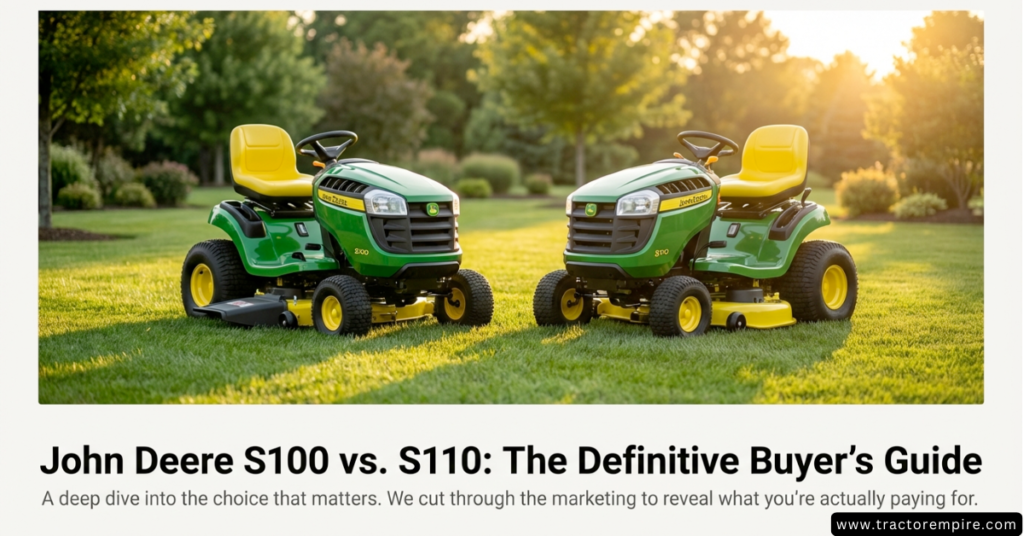
If you’ve spent any time comparing the John Deere S100 and S110, you’ve probably noticed something frustrating: they look nearly identical. Same 42-inch mower deck, same frame, same transmission, and yet one costs roughly $300 more than the other. What gives?
Here’s the thing about buying an entry-level lawn tractor, you’re walking a tightrope between budget and longevity. Overspend, and you’re paying for features you’ll never use. Underspend, and you’ll be nursing buyer’s remorse every time you fire up the engine. The John Deere 100 series sits right in this decision-making sweet spot, and the S100 vs S110 comparison is where most homeowners get stuck.
I’m here to strip away the marketing jargon and reveal the actual mechanical differences between these two riding lawn mowers. By the end of this guide, you’ll know exactly whether the S110’s upgrades are worth it for your specific yard or if you should pocket the savings and stick with the S100.
Key Takeaways
- The S110 offers only three meaningful upgrades: 1.5 HP more power, a larger seat, and minor aesthetic improvements
- Both models share the same 42-inch Edge™ cutting system and Tuff Torq transmission
- The power difference matters only in demanding conditions (thick wet grass, full baggers, heavy mulching)
- Your decision should be based on yard terrain, your height/comfort needs, and the current price gap
The “Cheat Sheet” (At-a-Glance Comparison)
Let’s cut to the chase. Here are the only differences that actually matter between the John Deere S100 and S110:
Engine Power
S100
17.5 HP
S110
19 HP
Both use Briggs & Stratton 33R877 single-cylinder engine
Seat Design
S100
11-inch Mid-Back
S110
15-inch High-Back
Enhanced lumbar support and ventilation on S110
Pricing
S100 MSRP
~$2,299
S110 MSRP
~$2,499
Price difference: $200-$300
QUICK VERDICT
The S110 is purely a comfort and slight torque upgrade. You’re getting the same transmission, same deck, and same cutting performance. The $200-$300 premium buys you a better seat and 1.5 HP more power—that’s it.
Everything else? Identical. Same deck. Same transmission. Same maintenance requirements. Same limitations.
Deep Dive: The 3 Main Differences
Most comparison articles stop at listing specs. That’s useless. What you need to know is how these differences actually affect your Saturday morning mowing routine.
A. The Engine Power Gap (17.5 HP vs. 19 HP)
The Spec Sheet Says: The S100 comes with a 17.5-horsepower single-cylinder engine, while the S110 bumps that up to 19 HP. Both use the same Briggs & Stratton Model 33R877 engine with a cast-iron cylinder liner for longer engine life and electronic ignition for quick starts.
The Reality Check: Does 1.5 HP actually matter?
For most homeowners mowing typical suburban lawns, the answer is no. Here’s when you’ll notice the difference:
Mowing flat, maintained grass: Zero difference. Both the S100 and S110 will cruise through your weekly mow at full throttle without breaking a sweat. The 17.5 HP engine has more than enough power to maintain blade tip speed on level terrain.
Mulching or bagging thick, wet grass: This is where the S110 shows its value. When you’re cutting 6-inch-tall grass after a week of rain, or when your bagger is half-full and you’re pushing through dense clumps, that extra 1.5 HP helps maintain consistent blade speed. The S100 will still get the job done—it’ll just bog down slightly more often, requiring you to slow down.
Towing attachments: Here’s the kicker—both models use the same Tuff Torq® hydrostatic transmission (more on this later). You’re limited by transmission strength, not engine power. The S110 doesn’t tow better than the S100.
The Takeaway: The power difference is noticeable only during “stress test” conditions—not during routine lawn maintenance. If you mow weekly and keep your grass at a reasonable height, you won’t miss those extra horses.
B. The Operator Station (The Seat Debate)
This is where the S110 actually earns its price premium.
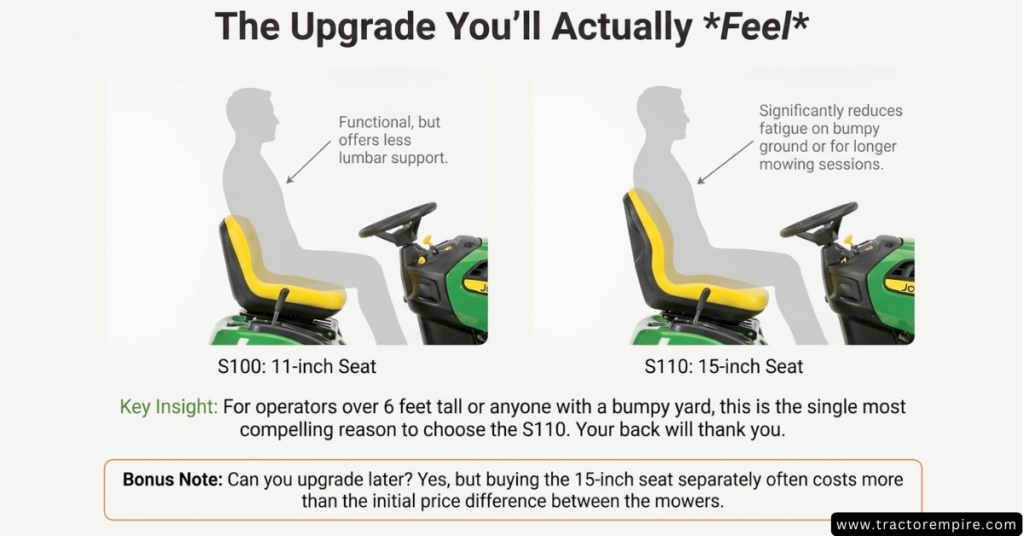
S100 Seat: Standard 11-inch mid-back seat. It’s functional and adequately padded, but it offers minimal lumbar support. Fine for shorter mowing sessions on smooth lawns.
S110 Seat: 15-inch open-back high-back seat with enhanced support. The taller backrest and open design provide significantly better lumbar support and ventilation.
Why This Actually Matters:
If you’re over 6 feet tall, the S100’s seat will feel cramped after about 30 minutes. The S110’s high-back design supports your entire spine, not just your mid-back. If you have a bumpy, uneven yard (roots, ruts, slopes), you’ll appreciate the additional support as you bounce around. The open-back design on the S110 also reduces heat buildup against your back during summer mowing.
The Modification Factor: Can you upgrade the seat later? Yes but this is where the math gets interesting. Buying a John Deere high-back seat separately costs $200-$250. You’re essentially paying the same price difference as buying the S110 upfront, except now you’re dealing with installation and potentially voiding aspects of your warranty. If seat comfort matters to you, buy the S110 from the start.
C. Aesthetic and Minor Trim Differences
The John Deere S110 includes a few cosmetic upgrades that don’t affect performance but make the tractor feel slightly more polished:
- Slightly more substantial fender flares
- Improved floor mat material (though both still use basic plastic)
- Marginally better-finished hood edges
Are these worth $300? Absolutely not. But they’re part of the package. Think of them as free bonuses that come with the seat upgrade.
What Remains Exactly the Same? (The “Shared DNA”)
This section could save you from making a costly assumption. Let me be crystal clear about what you’re NOT getting by upgrading to the S110.
The 42-Inch Edge™ Cutting System
Both the S100 and S110 use the identical 42-inch Edge cutting system mower deck. Same stamped steel construction. Same blade design. Same three-in-one blade options (side discharge, mulching, or rear bagging). Same cut quality.
If someone tells you the S110 cuts better, they’re wrong. The deck design, blade tip speed, and cutting performance are mechanically identical across both models.
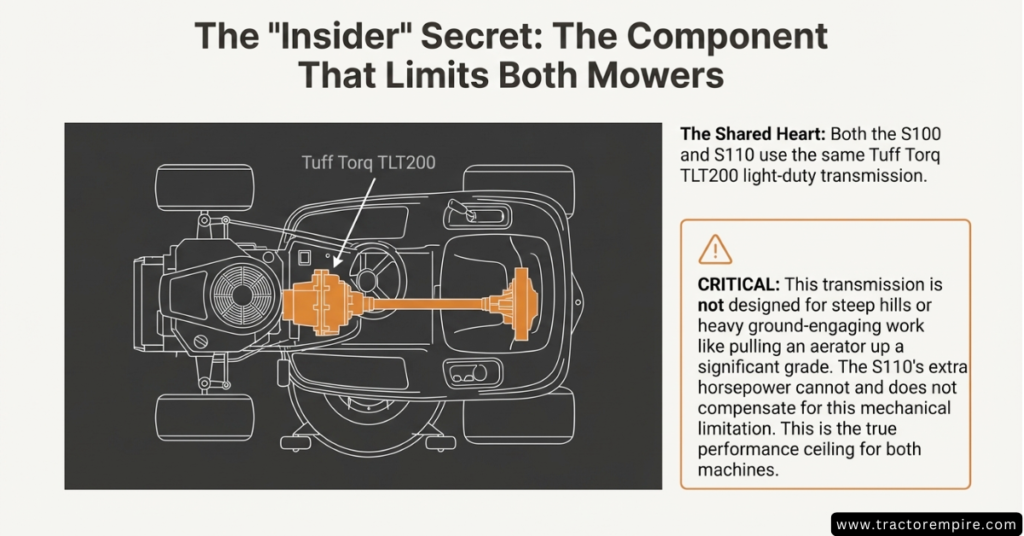
The Transmission (The Critical Weak Link)
Pay attention here—this is important.
Both the John Deere S100 and John Deere S110 use the Tuff Torq TLT200 (K46 variant) hydrostatic transmission. This Kanzaki® Tuff Torq® hydrostatic transmission offers a wide range of speeds and smooth, pedal-controlled operation through intuitively placed controls.
What does this mean for you?
- Neither machine is designed for steep hills. The K46 transmission is entry-level. It handles gentle slopes fine but struggles on anything approaching 15-20 degrees.
- Neither machine should pull heavy ground-engaging attachments. Light towing? Sure. A small cart with grass clippings? No problem. A loaded aerator or plow on damp ground? You’re asking for premature transmission failure.
- Buying the S110 does NOT get you a stronger transmission. This is the most common misconception. The extra 1.5 HP doesn’t translate to better towing or hill performance because the transmission is the bottleneck.
If you need serious towing capacity or have significant slopes, neither of these 100 series lawn tractors is the right choice. You need to step up to the S200 series or a John Deere X300 garden tractor.
Maintenance System (No “Easy Change” Oil System)
Here’s a detail that actually works in both models’ favor: neither the S100 nor S110 uses the controversial “Easy Change” 30-second oil system found on the S120 and higher models.
Both use traditional engine oil changes with standard filters and a no-tools oil drain valve. For DIY-minded homeowners who prefer proven, simple tractor maintenance procedures, this is actually a benefit. You can change the oil with basic tools, and there’s no proprietary system to potentially fail.
Both models also feature the same comfortable operator station layout with a spacious steering wheel and easy-to-reach controls. The fuel tank capacity, tire size, and overall dimensions are identical.
Performance Scenarios: Who Should Buy Which?
Forget generic pros and cons lists. Let’s talk about real-world scenarios that match your actual situation.
Scenario A: The Budget-Conscious Homeowner with a Flat Yard
Your Profile:
- You have a relatively flat ½ to ¾ acre lot
- You mow weekly during the growing season (grass stays under 4 inches)
- You’re looking to save money where it makes sense
- You’re under 6 feet tall with no back issues
- Your primary concern is reliable, affordable lawn care
My Recommendation: Buy the John Deere S100
The 17.5-horsepower single-cylinder engine has plenty of power for maintained grass on level ground. You won’t notice the power difference during routine mowing, and the standard seat is perfectly adequate for 30-45 minute mowing sessions on smooth terrain. Save the $200-$300 and put it toward maintenance supplies or a good set of mulching blades.
The S100 gives you the John Deere reliability and the proven 42-inch Edge cutting system without paying for comfort features you don’t need.
Scenario B: The “Rough Ride” Operator or Taller User
Your Profile:
- You have a bumpy, uneven 1-acre lot with ruts, roots, or gentle slopes
- You’re over 6 feet tall or have back issues
- You plan to bag leaves in the fall (adding weight and drag to the mower)
- You mow for 60+ minutes per session
- Comfort directly affects whether you enjoy or dread yard work
My Recommendation: Buy the John Deere S110
The extra 1.5 HP helps when the bagger is full and you’re pushing through thick autumn leaves. But the real value—the reason you’re spending the extra money is the 15-inch high-back seat. Your back will thank you after an hour of bouncing around an uneven lawn.
Think of it this way: if discomfort causes you to rush through mowing or dread the task, you’ll cut corners on lawn care quality. The S110’s enhanced operator station makes the job more pleasant, which means you’ll do it better and more consistently.
This is especially true for homeowners and professional landscapers who value comfort during extended use.
Scenario C: The Would-Be Upgrader (Heavy Duty Expectations)
Your Profile:
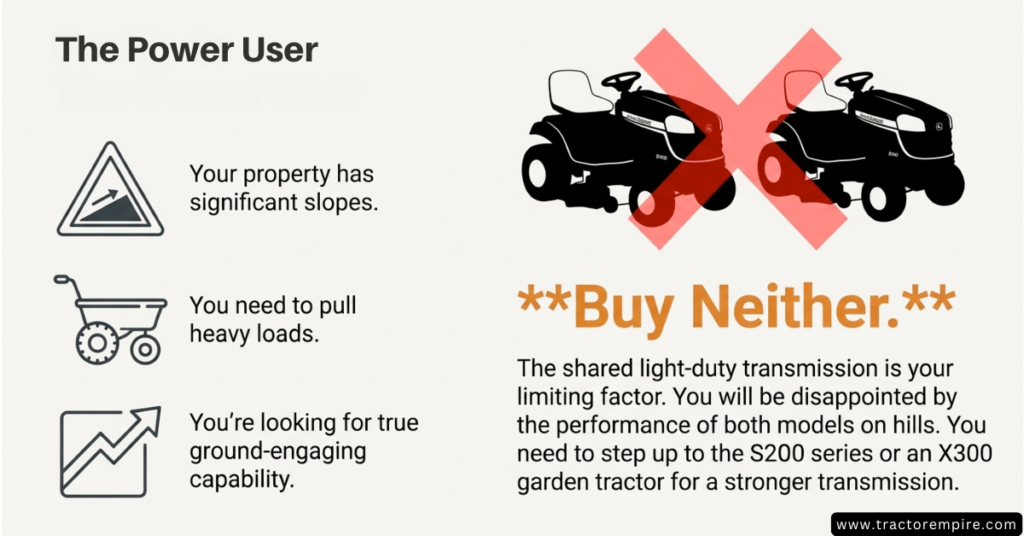
- You want to pull a heavy aerator, spreader, or multiple attachments
- You have steep hills or challenging terrain
- You’re considering snow removal with a blade attachment
- You have more than 1.5 acres to maintain
My Recommendation: Buy NEITHER—Step Up to S200 or X300 Series
This is harsh but honest: the S100 and S110 share the same entry-level Tuff Torq transmission. Neither machine is designed for what you’re asking it to do. You’ll be fighting transmission overheating, premature wear, and sluggish performance on slopes.
For larger lawns and tougher conditions, the S200 series offers a stronger K57 transmission and heavier frame. For true utility work, the X300 garden tractors provide genuine ground-engaging capability with a completely different transmission class.
Using an S100 or S110 for heavy-duty work is like using a sedan to tow a boat trailer—it might work, but you’re setting yourself up for expensive repairs.
The “Hidden” Costs & Long-Term Considerations
Beyond the sticker price, here are the factors that affect total cost of ownership:
Fuel Efficiency
The S100’s 17.5 HP engine is marginally more fuel-efficient than the S110’s 19 HP version—we’re talking about a difference of perhaps 0.1-0.2 gallons per mowing session. Over a season, this might save you $10-$15 in fuel costs.
For most homeowners, this difference is negligible. Don’t make your buying decision based on fuel economy alone.
Resale Value
Here’s an interesting market reality: the S110 holds its value slightly better on the used market. Why? The “higher spec” perception. When someone sees “19 HP” instead of “17.5 HP” in a classified ad, they assume it’s a better machine—even though the practical difference is minimal.
If you plan to sell your lawn tractor in 5-7 years, you might recoup $50-$100 more with the S110. Not a deciding factor, but worth noting.
Common Failure Points (Identical on Both Models)
Both the S100 and S110 share the same weak points:
Plastic hood hinges: These tend to crack after 3-5 years of UV exposure. Budget $30-$40 for replacements eventually.
Belt tensioners: The spring-loaded tensioners can wear out, causing belt slippage. This is a common issue across the entire 100 series and isn’t specific to either model.
Deck spindle bearings: With proper maintenance, these should last 5-7 years. Replacement runs $100-$150 per spindle.
The point? Neither model is more reliable than the other. They share the same parts and the same longevity profile.
Conclusion & Final Verdict
Let’s bring this full circle. The John Deere S110 is essentially the S100 with a “Comfort Package” upgrade. You’re paying $200-$300 for a better seat and 1.5 extra horsepower. That’s it.
Neither model offers a transmission upgrade, better deck, improved reliability, or enhanced cutting performance over the other. They’re mechanically near-identical machines with different operator stations and a marginal power difference.
The Smart Buying Strategy:
If the current price gap is less than $150: Buy the S110. At that price, the improved seat alone justifies the upgrade, and the extra power is a nice bonus for demanding mowing conditions.
If the price gap is $200-$250: This is the judgment call zone. If you’re tall, have back issues, or have a rough yard, lean toward the S110. If you have a smooth, flat yard and are under 6 feet, the S100 makes more financial sense.
If the price gap exceeds $250: Buy the S100 and invest the savings in quality accessories—a padded seat cover, a good set of mulching blades, or a maintenance kit. You’re getting 95% of the S110’s capability for significantly less money.
My Personal Take:
For most homeowners with typical suburban lots, the S100 is the better value. The 17.5 HP engine is completely adequate for maintained grass, and the standard seat works fine for mowing sessions under an hour.
The S110 makes sense for specific users: taller operators, those with bumpy terrain, or anyone who bags leaves and needs the extra torque when the bagger is loaded.
Don’t let marketing convince you that the S110 is a “better” machine in some fundamental way. It’s the same reliable John Deere 100 series riding lawn mower with a few comfort upgrades. Buy based on your actual needs, not on spec-sheet psychology.
Both the S100 and S110 represent reliable and affordable options for homeowners seeking high-quality lawn maintenance without stepping up to the higher-priced 200 or 300 series. Either model will serve you well with proper care.
Just make sure you’re paying for features you’ll actually use, not for bragging rights at the box store.
Frequently Asked Questions
Can I install a snow plow on the S100 or S110?
Yes, but with significant limitations. Both models can accept light-duty snow plow attachments designed for the 100 series lawn tractor. However, the K46 transmission isn’t designed for heavy-resistance ground-engaging work.
You can handle 2-4 inches of light, fluffy snow on a flat driveway. Anything heavier, wetter, or on an incline risks transmission damage. For serious snow removal, you need a purpose-built snow blower attachment or a heavier tractor.
Check with your local John Deere dealer about which attachments are warranty-approved for the 100 series.
Is the S110 faster than the S100?
No. Both models top out at approximately 5.5 mph in forward speed. The hydrostatic transmission offers the same wide range of speeds on both tractors. The extra horsepower doesn’t increase top speed—it only affects how well the mower maintains speed under load.
Do they use the same bagger?
Yes. The 42-inch rear bagger attachment fits both the S100 and S110 identically. Same mounting points, same capacity, same installation procedure. If you already own a bagger for one model, it will work perfectly on the other.
How long do these lawn tractors typically last?
With proper maintenance (regular oil changes, air filter replacement, blade sharpening), both the John Deere S100 and S110 should provide 10-15 years of service for residential use. The cast-iron cylinder liner contributes to longer engine life compared to all-aluminum designs.
The transmission is usually the first major component to fail, typically around the 7-10 year mark with average use. Engine longevity typically outlasts transmission life on these entry-level riding lawn mowers.
Can I service these myself or do I need to go to a dealer?
Both models are DIY-friendly for routine maintenance. Oil changes, air filters, spark plugs, and blade replacement are straightforward. The no-tools oil drain valve makes engine oil changes particularly easy.
For transmission service, deck belt replacement, or electrical issues, you’ll likely want to visit a JD dealer unless you’re mechanically inclined. One advantage of buying new John Deere turf and utility equipment from an authorized Deere dealer is the warranty for new John Deere turf and utility equipment at johndeere.com, which covers major component failures in the first two years.
Which model is better for mulching?
Neither has an advantage in mulching capability—both use the identical 42-inch Edge cutting system with the same mulching blade design. However, the S110’s extra 1.5 HP helps maintain blade speed when mulching thick, damp grass, resulting in slightly more consistent mulching performance in challenging conditions.
For typical mulching (3-4 inch grass heights), both perform identically.