It happens every spring. You’re staring at your overgrown lawn, and that beat-up push mower suddenly feels like manual labor you’re no longer willing to endure. Or maybe your old riding mower finally gave up the ghost after one too many seasons.
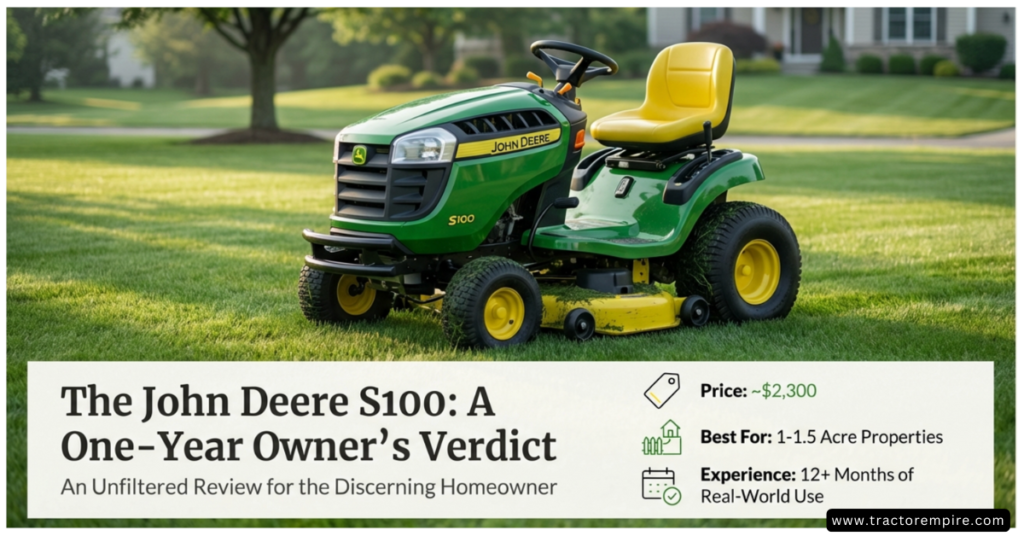
You start researching lawn tractors, and the John Deere S100 keeps appearing in your search results. At roughly $2,300, it’s the entry-level gateway into the iconic Green & Yellow brand. But here’s the question that keeps you up at night: Is this just an expensive toy that’ll break down in two years, or is it actually worth the investment?
I’ve been exactly where you are. A year ago, I upgraded from a series of cheap “throwaway” mowers that lasted 2-3 seasons before becoming lawn ornaments. I needed something reliable for my 1-acre lot without emptying my savings account. After 12 months of real-world testing, including letting it sit through an entire winter, I’m ready to give you the unfiltered John Deere S100 review.
This isn’t a regurgitated spec sheet. This is what happens when you actually own this mower for a full year.
Key Takeaways
- Best For: 1-1.5 acre flat suburban yards with minimal obstacles
- Price Point: $2,200-$2,300 (entry-level John Deere quality without commercial pricing)
- Engine: 17.5 HP Briggs & Stratton with hydrostatic transmission
- Cut Quality: Smooth, carpet-like finish on residential lawns
- Major Pro: Reliable starting, fuel-efficient, dealer support network
- Major Con: Plastic hood construction, not suitable for hills or rough terrain
- Verdict: Best value for homeowners escaping the “throwaway mower” cycle
Who Is the John Deere S100 Lawn Tractor Actually For
Before we dive into performance specs and dealer strategies, let’s address the elephant in the room: this mower isn’t for everyone. Understanding whether the S100 matches your property will save you from buyer’s remorse.
The Ideal S100 Owner Profile
Perfect yard size: 1 to 1.5 acres. You can push it to 2 acres if you’re patient, but at that point, you’re better off looking at a zero turn mower. Anything under 1 acre? You’re probably overspending, a quality push mower or a smaller riding mower like the E100 makes more sense.
Terrain requirements: Flat to slightly uneven suburban yards. This is where the S100 shines. The hydrostatic transmission glides smoothly over gentle contours, and the 42-inch deck handles open spaces efficiently.
Where the S100 Struggles (And You’ll Regret Buying It)
Let me be blunt: If you have steep hills, don’t buy this tractor.
The S100 uses a K46 transmission that simply doesn’t have the muscle for aggressive inclines. I learned this the hard way when visiting a friend’s property with a 15-degree slope. The mower struggled for traction, and I could feel the belt slipping. It’s not a safety issue, but it’s frustrating and inefficient.
Rough, wooded terrain with hidden obstacles? Also a poor match. I once tried mowing near an area with cypress knuckles (those gnarly tree root protrusions), and the 42-inch mower deck took a beating. The S100 is built for manicured residential lawns, not obstacle courses.
Complex obstacle navigation: The 18-inch turning radius is adequate for open yards, but if you have elaborate flower beds, tight tree lines, or constant maneuvering around decorations, you’ll find yourself doing a lot of three-point turns. A zero turn would handle these situations far better.
The Big Box Store Myth: Lowe’s vs. John Deere Dealers
Here’s a question I see constantly in forums: “Is the S100 at Lowe’s the same quality as the one at a JD dealer, or is it a cheaper version?”
Let me settle this once and for all: It’s the exact same mower. Same engine, same deck, same transmission, same everything. John Deere doesn’t manufacture “lesser” versions for big box retailers. The model number, serial number format, and warranty are identical.
So why does this myth persist? Because the buying experience is radically different and that difference matters more than you think.
Option A: Big Box Stores (Lowe’s/Home Depot)
The appeal is obvious:
- Convenient locations with weekend availability
- Competitive financing deals (0% APR promotions)
- Ability to see inventory and check pricing online
- Sometimes slightly lower upfront costs
The hidden problems: When you buy from Lowes or Home Depot, you’re getting third-party assembly and delivery. Let me tell you what happened when my S100 arrived from Lowe’s:
The delivery driver backed the mower off his truck, handed me a clipboard, and drove off in under five minutes. No walkthrough. No starting demonstration. And no explanation of the safety features. When I tried to start it an hour later, the battery was completely dead—it had been sitting in a warehouse for who knows how long.
I’m reasonably handy, so I jumped it with my car battery and threw it on a trickle charger overnight. Crisis solved. But if you’re not comfortable with basic troubleshooting, that dead battery becomes a service call and wasted weekend.
Option B: Authorized John Deere Dealers
What you’re actually paying for:
- Expert assembly with PDI (Pre-Delivery Inspection): Every bolt checked, fluids topped, deck leveled, tire pressure verified
- Personalized walkthrough: They’ll show you how to engage the parking brake, operate the PTO, adjust the deck height, and use the reverse mowing feature
- Stronger warranty relationship: When something goes wrong, you’re calling someone who knows your machine’s service history
- Mobile service options: Many dealers offer free house calls for warranty work or charge minimal fees for on-site maintenance
My recommendation: If you’re not confident troubleshooting a dead battery, checking oil levels, or adjusting belt tension, buy from an authorized dealer. The $100-$200 premium (if any) pays for itself in peace of mind.
| Related: Best Lawn Tractor 2026: Expert Reviews & Buying Guide
The Serial Number Hack: Don’t Buy 2-Year-Old “New” Inventory
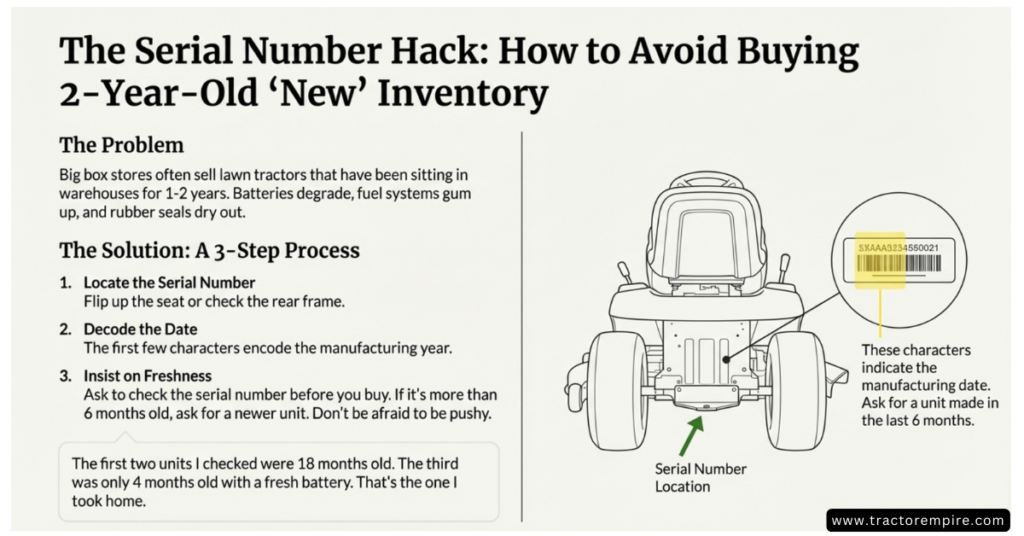
Here’s something most reviews won’t tell you: Big box stores often sell lawn tractors that have been sitting in inventory for 1-2 years.
Batteries degrade. Fuel systems gum up. Rubber seals dry out. You’re essentially buying a “new” mower that’s already aging before you even start it.
How to Check the Manufacturing Date
Flip up the seat or check the rear frame. You’ll find a sticker with the serial number. The first few characters encode the manufacturing year. For John Deere 100 series tractors, the format typically starts with “1LV” followed by the model designation and production year indicator.
Here’s what to do:
- Ask the store associate to check the serial number before you commit to purchase
- If they tell you it’s more than 6 months old, ask if they have fresher inventory in the back
- Don’t be afraid to be pushy. You’re spending $2,300. You deserve a mower that was built recently.
When I bought mine, I politely insisted on checking three units. The first two were manufactured 18 months prior. The third was only 4 months old with a fresh battery. That’s the one I took home.
Technical Specs & Features: What Actually Matters
Let’s talk about what’s under the hood and what those specs mean in real-world performance.
Engine & Power: The Heart of the John Deere S100
The S100 runs a 17.5 HP Briggs & Stratton (B&S) single-cylinder engine. For context, this isn’t the 22 horsepower you’d find in the 300 series, but it’s perfectly adequate for residential mowing.
Top speed: Approximately 5.5 mph forward. That might sound slow, but trust me—you’re not racing this thing around your yard. It’s the ideal cruising speed for a clean, even cut without scalping.
Hydrostatic transmission: This is one of my favorite features. Instead of shifting gears like a manual car, you have two pedals—one for forward, one for reverse. Press harder, you go faster. Release, you slow down. It’s intuitive and smooth, with no grinding gears or lurching starts.
The 42-Inch Deck: Your Cutting Weapon
The Edge Cutting System isn’t revolutionary, but it’s reliable. The 42-inch deck size strikes a nice balance—wide enough to cover ground efficiently but narrow enough to fit through most garden gates.
13 height positions: This is crucial and often overlooked. In spring, when grass grows aggressively, I mow at 3.5 inches. In the dry summer months, I raise it to 4 inches to protect the lawn from heat stress. Having this flexibility means your grass stays healthier year-round.
Electric blade engagement (PTO): Pull the yellow knob, and the deck belt spins up the blades. No manual lever wrestling. Simple.
Reverse mowing capability: The S100 includes a feature that lets you mow in reverse (critical for tight spaces), but you have to deliberately press a safety button to override the automatic blade disengagement. It’s a minor inconvenience that prevents accidents, so I don’t mind it.
Build Quality: The Plastic Hood Controversy
This is where opinions get heated. The S100 hood is plastic, not steel.
Pros of plastic:
- Won’t rust (huge benefit if you live in humid climates)
- Lightweight, making it easy to lift for oil changes
- Lower manufacturing cost keeps the price point accessible
Cons of plastic:
- Feels cheaper than steel hoods on higher-end models
- Risk of cracking if you accidentally back into a tree branch or hit it with a tool
- After a year, mine shows minor surface scratches but no cracks
Would I prefer steel? Sure. But I haven’t had structural issues, and the rust-free benefit is legitimate.
The Flimsy Fuel Gauge (My Biggest Gripe)
The fuel gauge on the S100 is a manual float system—a little bobber that rises and falls with the gas level. It works, but it feels cheap. The mechanism bobs around while you’re mowing, and I’m honestly surprised it hasn’t broken yet.
Workaround: I just visually check the tank before each mow. It takes 10 seconds, and I never worry about running out mid-cut.
| Related: John Deere X300 Lawn Tractor Specs, Features & Performance
Real-World Performance: My 1-Year Report Card
Enough specs. Let’s talk about how this lawn mower actually performs week after week.
Starting Reliability: Zero Drama
This is where the John Deere S100 truly earns its reputation. After letting it sit dormant through an entire winter (with a charged battery), it started on the first turn of the key in spring. No hesitation. No sputtering. Just immediate ignition.
I’ve mowed approximately 35 times in the past year, and it has started flawlessly every single time. For someone who owned mowers that required 15 minutes of coaxing and prayer, this reliability is worth every penny.
Cut Quality: Carpet-Like Finish
The cut quality on flat lawns is exceptional. Even distribution, no uncut strips between passes, and a smooth finish that makes your yard look professionally maintained.
Important note: The cut quality degrades noticeably when the blades dull. I sharpen mine every 20-25 hours of mowing (roughly every 4-6 weeks during peak season). If you mow over sticks or rough patches frequently, plan on sharpening more often.
Fuel Efficiency: Better Than Expected
Here’s some hard data: My 1-acre lot uses approximately one-third of a tank per mow. With a full tank, I can complete three full mowing sessions before refilling.
At current gas prices, that’s roughly $8-10 per month in fuel during peak season. For comparison, my old mower guzzled nearly twice as much.
Ride Comfort: Good Enough for an Hour
The adjustable seat (2-inch slide range) is adequate but not luxurious. I’m an Army vet with chronic back issues, and I can comfortably mow for 45-60 minutes without needing a break. The seat padding is firm but supportive.
The hydrostatic transmission contributes significantly to comfort—no jarring shifts or grinding transitions. It’s smooth enough that I can hold a coffee cup while mowing (though I don’t recommend it).
Maintenance & Longevity: Keeping Your Investment Running
A lawn tractor is only as good as your willingness to maintain it. Fortunately, the S100 is designed with homeowner-friendly maintenance in mind.
Blade Care: The Foundation of Performance
Sharp blades = clean cuts. Dull blades = torn grass that turns brown and invites disease.
I sharpen or replace my blades every 20-25 hours. If you’re not comfortable removing and sharpening blades yourself, any small engine shop will do it for $15-20. Budget 2-3 blade sharpenings per season.
The Wash Port: Use It or Regret It
Under the deck, there’s an integrated wash port. Hook up your garden hose, turn on the water, start the mower, and engage the blades. The spinning action flushes out clippings and prevents rust buildup.
Use this after every mow. Seriously. Grass clippings compact under the deck and create moisture pockets that accelerate corrosion. Two minutes of hosing saves years of deck life.
Oil Changes: The “Easy Change” System
The S100 uses John Deere’s Easy Change oil system, which some people love and others find gimmicky. Here’s the reality: The access point under the flip-up hood is convenient, and doing a regular oil change takes about 15 minutes.
I use conventional 10W-30 engine oil (not synthetic, as Briggs & Stratton doesn’t require it). Change the oil every 50 hours or once per season—whichever comes first.
MowerPlus App: Tracking Made Simple
The S100 is compatible with the MowerPlus app, which helps you track maintenance intervals, log mowing hours, and set reminders for belt replacement or deck belt inspections. It’s not essential, but if you’re forgetful about maintenance, it’s worth downloading.
Pros & Cons: The Unfiltered Truth
After a full year, here’s my honest assessment based on both personal experience and broader online sentiment from tractor owners and enthusiasts in the forum community dedicated to JD equipment.
Should You Buy the John Deere S100? My Final Verdict
After 12 months of ownership, here’s my bottom-line recommendation:
Buy the John Deere S100 if you:
- Own a flat, 1-1.5 acre lot with minimal obstacles
- Want to escape the “cheap mower replacement cycle” without spending $4,000+
- Value reliable starting and consistent performance
- Appreciate dealer support and parts availability
- Are willing to perform basic seasonal maintenance
Skip the S100 if you:
- Have steep hills or rough, uneven terrain (look at the S130 or higher models with more power)
- Need a tight turning radius for complex landscaping (consider a zero turn)
- Own less than 1 acre (the E100 or even a quality push mower makes more sense)
- Expect commercial-grade durability (this is residential-duty equipment)
The $2,300 Question: Is It Worth It?
For my specific needs—1 acre, flat suburban yard, weekly mowing—absolutely. The S100 has proven reliable, efficient, and capable. It’s not perfect (that fuel gauge still annoys me), but it delivers consistent results without the drama of budget brands.
One critical caveat: Buy from an authorized John Deere dealer, not Lowe’s or Home Depot, unless you’re comfortable handling potential delivery issues. The dealer markup is minimal compared to the value of proper assembly, a charged battery, and a personalized walkthrough.
The John Deere S100 lawn tractor occupies a specific sweet spot: premium enough to last for years, affordable enough to justify for residential homeowners. If that describes your situation, you won’t regret the investment.
Frequently Asked Questions
How does the John Deere S100 compare to the S120?
The S120 offers a slightly larger 42-inch deck with improved cut quality and LED lights, but the core engine (17.5 HP) remains the same. Unless you mow frequently at dusk or need the marginal deck upgrade, the S100 offers better value
Can I use the S100 for mulching or bagging grass clippings?
Yes, but you’ll need to purchase the mulch kit or bagger attachment separately. The standard configuration side-discharges clippings. I find side discharge perfectly adequate for my lawn.
What’s the life expectancy of the John Deere S100?
With proper maintenance (regular oil changes, blade sharpening, deck cleaning), you should expect 8-12 years of reliable service for residential use. Neglect maintenance, and that drops to 4-6 years.
Is the hydrostatic transmission reliable long-term?
The K46 transmission used in the S100 is proven and reliable for residential applications. As long as you don’t abuse it on steep hills or overload it with heavy attachments, it should outlast the mower’s useful life.
Can I disengage the deck belt easily if I need to replace it?
Yes, the deck belt is accessible and can be replaced by a moderately handy homeowner in about 30-45 minutes. YouTube has excellent JD-specific tutorials for troubleshooting and belt replacement
Does the parking brake hold reliably on slight inclines?
The parking brake is adequate for gentle slopes but not aggressive inclines. On my slightly sloped driveway, it holds fine. I wouldn’t trust it on anything steeper than 5-7 degrees