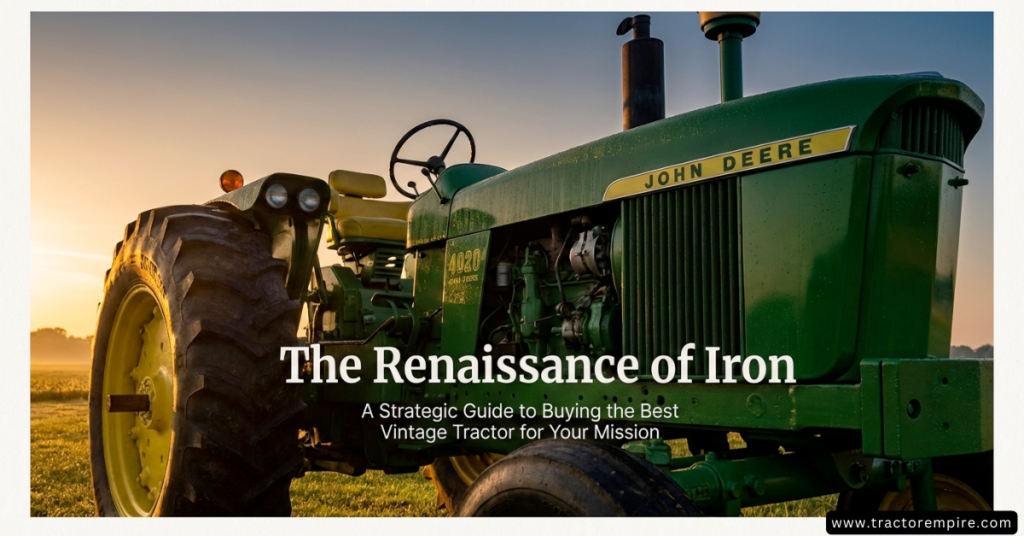
There’s something magnetic about the low rumble of a 1950s John Deere two-cylinder engine firing up on a cold morning. Maybe it’s nostalgia, or maybe it’s the growing realization that these mechanical marvels were built to last, unlike many modern machines programmed with planned obsolescence.
In 2026, vintage tractors aren’t just farm equipment anymore. They’re investments, restoration projects, and weekend hobbies that connect us to an era when you could fix your own machinery with a wrench set and determination. The Right to Repair movement has driven renewed interest in pre-computer tractors, while collectors are discovering that well-maintained classics appreciate faster than many traditional investments.
But here’s the critical question: Which vintage tractor actually deserves your garage space and hard-earned money?
This guide breaks down the absolute best vintage tractors across three categories, whether you’re planning to plow fields, parade down Main Street, or park your money in appreciating iron. I’ve spent two decades working with agricultural equipment and restoration communities, and I’ll walk you through exactly what makes each machine special, what they cost in today’s market, and the hidden pitfalls that can turn a dream purchase into a financial nightmare.
Key Takeaways
- The Ford 8N and Massey Ferguson 135 offer unbeatable parts availability and reliability for working homesteads
- John Deere 4020 tractors have appreciated 40-60% over 15 years, making them the best investment-grade vintage tractor
- Always perform a cold-start inspection—warm engines hide expensive problems like worn rings and head gasket failures
- Budget $1,200-1,500 for rear tire replacement when negotiating, as this is the most common hidden cost
- Allis-Chalmers and Oliver tractors deliver comparable capability to John Deere for 20-30% less money
- The Renaissance of Iron: Understanding Vintage Tractor Classifications
- Category 1: The "Homestead Heroes" (Best for Real Work)
- Category 2: The "Blue Chip" Investments (Best for Collectors)
- Category 3: The Underrated Gems (Best Budget Buys)
- Critical Comparison: Top 5 Vintage Tractors at a Glance
- How to Buy a Vintage Tractor: The 15-Minute Inspection Checklist
- Maintenance & Restoration: The Reality Check
- Conclusion: Matching the Machine to Your Mission
- Frequently Asked Questions
The Renaissance of Iron: Understanding Vintage Tractor Classifications
Before we dive into specific models, let’s establish what “vintage” actually means in the tractor world because the terminology matters when you’re spending thousands of dollars.
Here’s what’s driving the 2026 vintage tractor boom: farmers are tired of $150 diagnostic fees for computerized equipment they can’t fix themselves, investors are recognizing tangible assets that hold value during economic uncertainty, and hobbyists are rediscovering the satisfaction of turning wrenches without needing proprietary software.
Matching the Machine to Your Mission
The “best” vintage tractor is entirely dependent on your use case:
- Working a small farm or homestead? You need reliability, parts availability, and attachment compatibility.
- Building a collection or investment portfolio? Focus on desirability, appreciation potential, and market liquidity.
- Weekend warrior on a budget? Look for undervalued brands with strong capabilities and reasonable parts support.
Let’s break down the champions in each category.
Category 1: The “Homestead Heroes” (Best for Real Work)
These tractors prioritize what actually matters when you’re mowing 10 acres, moving hay bales, or maintaining a small farm: they start reliably, parts arrive in days (not months), and the three-point hitch doesn’t leave you cursing on a Sunday afternoon.
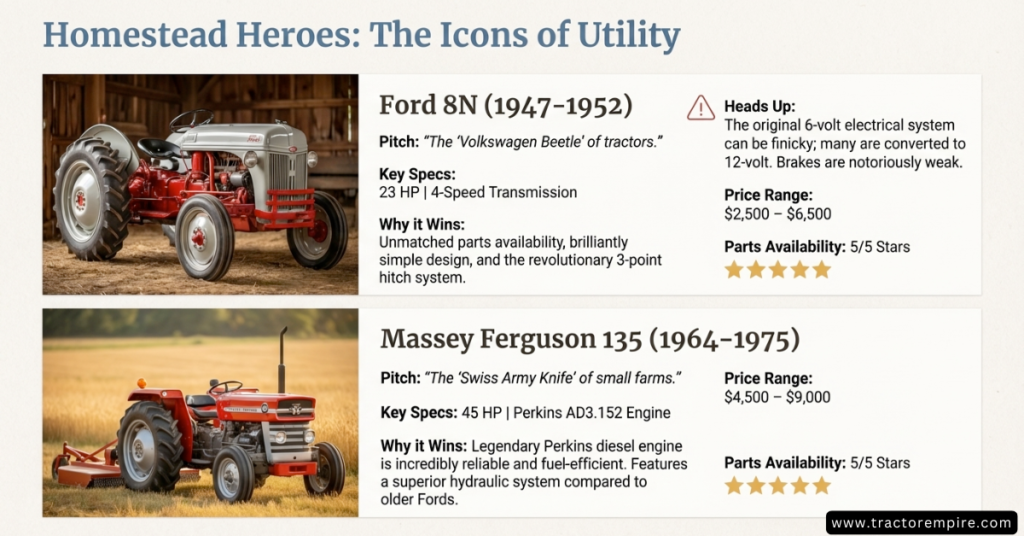
1. Ford 8N (1947-1952): The Volkswagen Beetle of Tractors
Why It Wins: If vintage tractors had a “most likely to succeed” award, the Ford 8N would win unanimously.
Ford produced over 500,000 of these machines, which means two critical things for modern buyers: parts are everywhere and cheap, and every small-engine mechanic within 50 miles knows how to work on them. The 8N introduced many farmers to the modern three-point hitch system (developed with Ferguson), revolutionizing implement attachment.
Key Specifications:
- Horsepower: 23-25 HP
- Transmission: 4-speed manual
- Weight: Approximately 2,400 lbs
- Fuel Type: Gasoline
What You Need to Know: The 6-volt electrical system is the 8N’s Achilles heel. Most owners eventually convert to 12-volt for reliable starting ($200-400 conversion). The brakes are notoriously weak by modern standards, plan on using engine compression for stopping on hills. Rear tires in good condition can run $800-1,200 for the pair, so factor this into purchase negotiations.
2026 Price Range: $2,500 (needs work) to $6,500 (fully restored)
Parts Availability Score: 5/5 ⭐
Best For: First-time tractor owners, budget-conscious homesteaders, mowing and light groundwork
Pro Tip: The 1952 models featured improved hydraulics over earlier years. If choosing between similar-condition tractors, always grab the later model year.
2. Massey Ferguson 135 (1964-1975): The Swiss Army Knife of Small Farms
Why It Wins: While the Ford 8N gets all the glory, experienced farmers quietly prefer the MF 135 for one reason: the legendary Perkins AD3.152 diesel engine.
This three-cylinder British powerplant is renowned for fuel efficiency and longevity. Owners regularly report 10,000+ hours with basic maintenance. The hydraulics are notably superior to the N-series Fords, giving you better control for loader work and precision implements.
Key Specifications:
- Horsepower: 45-47 HP (diesel), 37-40 HP (gas)
- Transmission: 8-speed with Multi-Power option
- Weight: Approximately 3,400 lbs
- Fuel Type: Diesel or gasoline variants
What You Need to Know: The Multi-Power transmission (essentially an on-the-go two-speed splitter) transforms this tractor’s versatility. You get 16 forward speeds without stopping. The diesel variants command $1,000-2,000 premiums over gas versions, but diesel is mandatory if you’re doing serious fieldwork.
2026 Price Range: $4,500 (good condition) to $9,000 (restored with Multi-Power)
Parts Availability Score: 5/5 ⭐
Best For: Serious homesteaders, those needing real horsepower, hay operations
3. Ford 4000/5000 Series (1965-1976): Blue Power’s Mid-Sized Legend
Why It Wins: When 23 horsepower isn’t enough but you don’t need a 100 HP monster, the Ford 4000/5000 series hits the sweet spot.
These tractors marked Ford’s transition to higher-horsepower utility machines. The heavier chassis handles bigger implements without bouncing across the field, and the renowned Ford durability means many are still working daily on farms across America.
Key Specifications:
- Horsepower: 4000: 52-55 HP | 5000: 60-65 HP
- Transmission: 8-speed SelectOSpeed
- Weight: 5,000-6,000 lbs
- Fuel Type: Diesel preferred
What You Need to Know: The Select-O-Speed transmission is either loved or hated, there’s no middle ground. When working properly, it’s fantastic for loader work. When it fails, repairs run $2,000-3,000. Standard transmission models are more reliable for field work. Diesel models are far more common and desirable than gas variants.
2026 Price Range: $6,000 (standard transmission) to $12,000 (restored Select-O-Speed)
Parts Availability Score: 4.5/5 ⭐
Best For: Mid-sized properties, heavy implements, those who’ve outgrown compact tractors
Category 2: The “Blue Chip” Investments (Best for Collectors)
These tractors transcend utility, they’re cultural icons that command respect at shows, appreciate steadily in value, and offer high liquidity when it’s time to sell.
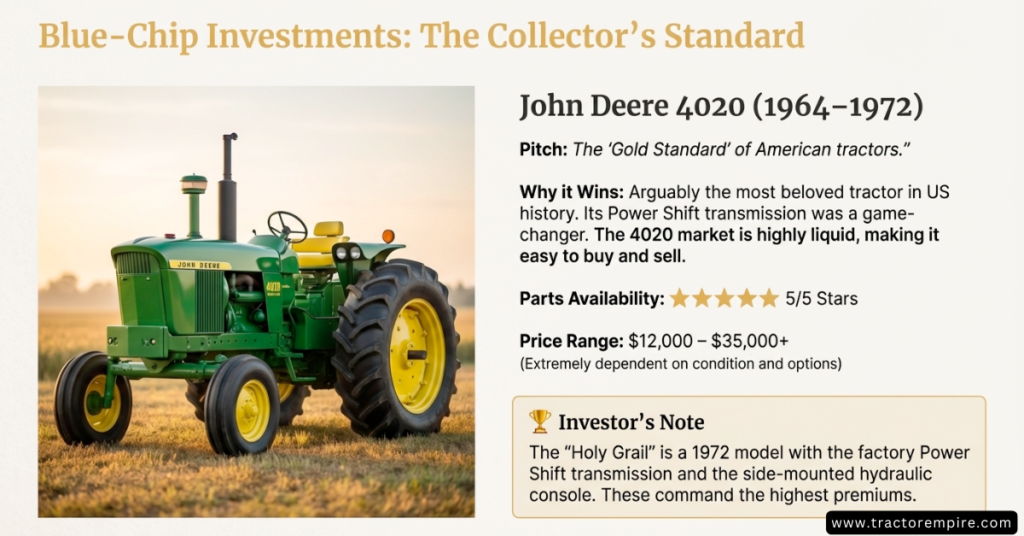
4. John Deere 4020 (1964-1972): The Gold Standard of American Tractors
Why It Wins: Ask any vintage tractor expert to name the single most influential machine of the modern era, and “4020” is the answer you’ll hear most often.
The 4020 introduced the Power Shift transmission, eight synchronized gears you could shift without clutching, that changed farming forever. It arrived at the perfect intersection of power (90+ HP), reliability, and operator comfort. Baby boomers who grew up watching Dad drive a 4020 are now buying them for nostalgia, driving values steadily upward.
Key Specifications:
- Horsepower: 84-95 HP (varied by year/fuel)
- Transmission: Synchro-Range or Power Shift
- Weight: 7,500-8,500 lbs
- Fuel Type: Diesel, gas, or LP variants
The Holy Grail Alert: The 1972 Power Shift Side Console models represent peak desirability. These feature the operator controls moved to the right-hand console (like a modern tractor), making them the most comfortable and commanding the highest premiums, often $35,000+ for pristine examples.
What You Need to Know: The diesel variants are most desirable, particularly the turbocharged models. Standard non-console models are more affordable entry points. Original unrestored examples in working condition often appreciate faster than over-restored show tractors.
2026 Price Range: $12,000 (project tractor) to $35,000+ (1972 Side Console, fully restored)
Parts Availability Score: 5/5 ⭐
Appreciation Potential: Strong—values have increased 40-60% over the past decade
Best For: Serious collectors, investment-focused buyers, nostalgia seekers
Market Insight: A well-documented 4020 with original serial-numbered parts is worth significantly more than one with replacement components. Keep all receipts and restoration documentation.
5. Farmall M / Super M (1939-1954): The Row-Crop King
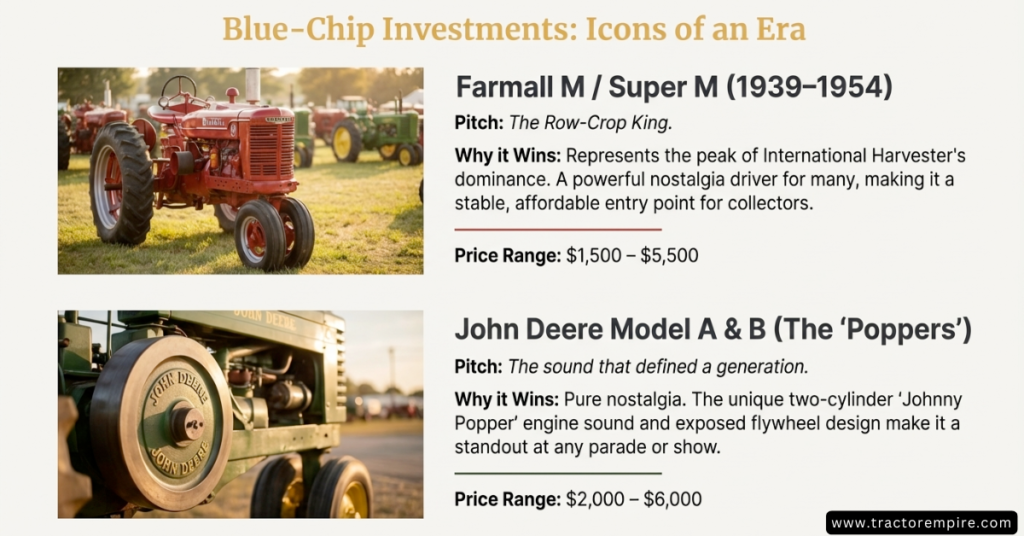
Why It Wins: Before John Deere dominated American agriculture, International Harvester ruled the fields and the Farmall M was their flagship.
This tractor represents the golden age of IH engineering. The narrow front end and adjustable rear wheels made it perfect for cultivating row crops like corn and cotton. For baby boomers, the Farmall M evokes powerful memories of family farms and agricultural heritage.
Key Specifications:
- Horsepower: M: 36 HP | Super M: 46 HP
- Transmission: 5-speed manual
- Weight: 5,200-5,600 lbs
- Fuel Type: Gasoline, distillate, or diesel (rare)
What You Need to Know: The Super M (1952-1954) commands premiums over the standard M, offering more horsepower and improved hydraulics. Wide-front models are more common; narrow-front “tricycle” configurations are most desirable to collectors. Diesel Super M models are exceptionally rare and valuable.
2025 Price Range: $2,500 (fair condition standard M) to $8,000 (restored Super M)
Parts Availability Score: 4/5 ⭐
Best For: IH enthusiasts, affordable collector entry point, those wanting row-crop capability
6. John Deere Model A & B: The “Johnny Poppers”
Why They Win: The sound. That unforgettable two-cylinder “pop-pop-pop” is instantly recognizable and deeply nostalgic.
These tractors defined John Deere’s pre-war identity. The Model A (larger) and Model B (smaller) used horizontal two-cylinder engines with massive exposed flywheels, a design that became synonymous with the brand until 1960.
Key Specifications:
- Model A Horsepower: 24-38 HP (varied by year)
- Model B Horsepower: 16-27 HP (varied by year)
- Production Years: A: 1934-1952 | B: 1935-1952
- Unique Feature: Two-cylinder horizontal engine design
What You Need to Know: Late-styled models (post-1947) with “Roll-O-Matic” front wheels are most desirable. Unstyled early models attract purists but command lower values. Electric start models are far more convenient than hand-crank variants.
2025 Price Range: $3,000 (unstyled project) to $12,000 (late-styled, restored)
Parts Availability Score: 4.5/5 ⭐
Best For: Nostalgia collectors, parade tractors, JD brand enthusiasts
Category 3: The Underrated Gems (Best Budget Buys)
These tractors deliver exceptional capability for significantly less money than equivalent John Deeres or Farmalls. Smart buyers recognize value where others see orange and green.
7. Allis-Chalmers WD45 (1953-1957): The Orange Innovation
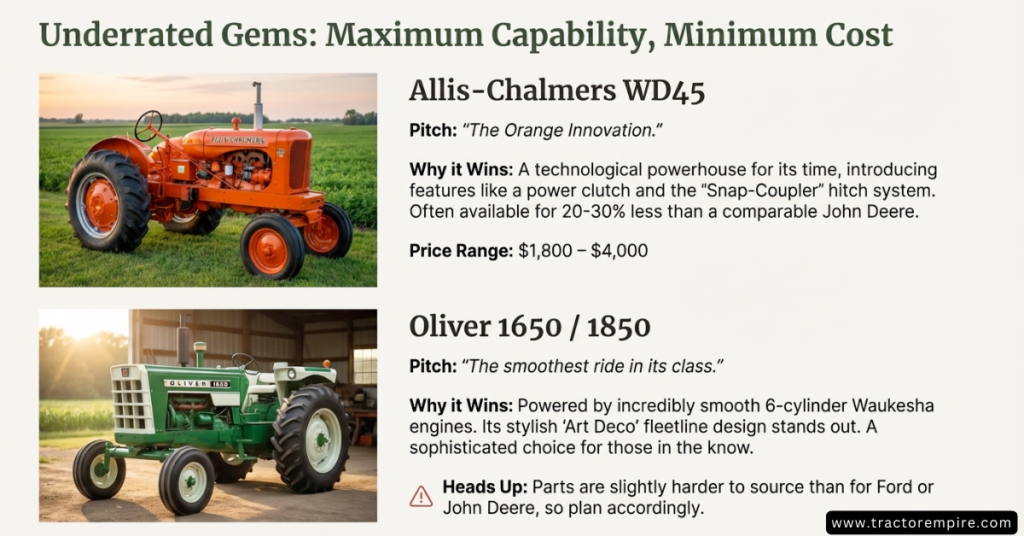
Why It Wins: Allis-Chalmers doesn’t command John Deere premiums, which means you can get comparable sometimes superior engineering for 20-30% less money.
The WD45 introduced power-adjusted rear wheels, the Snap-Coupler quick-hitch system (a predecessor to the three-point hitch), and a power clutch that allowed on the go implement engagement. These were genuine innovations that just happened to be painted Persian Orange instead of green.
Key Specifications:
- Horsepower: 35-40 HP
- Transmission: 4-speed manual
- Weight: Approximately 4,200 lbs
- Fuel Type: Gasoline or diesel
What You Need to Know: The WD45 diesel variant is particularly desirable but harder to find. The power-adjusted rear wheels (Traction Booster) gave infinitely variable wheel spacing a feature modern tractors charge thousands extra for.
2025 Price Range: $1,800 (needs attention) to $4,000 (good working condition)
Parts Availability Score: 3.5/5 ⭐
Best For: Budget-conscious buyers, those who appreciate engineering over brand names
Value Play: AC tractors consistently sell for less at auctions than comparable JD or IH models, despite often superior features. This makes them excellent working investments.
8. Oliver 1650/1850 (1964-1969): The Smoothest Ride in History
Why They Win: Oliver tractors are the automotive equivalent of hidden luxury sophisticated engineering wrapped in understated styling.
The six-cylinder Waukesha engines in these models run smoother than anything else from this era. The “Fleetline” Art Deco styling turns heads, and the Hydra-Power drive (Oliver’s version of a power-shift transmission) was genuinely ahead of its time.
Key Specifications:
- Horsepower: 1650: 66 HP | 1850: 76 HP
- Transmission: 6-speed with Hydra-Power option
- Weight: 6,500-7,200 lbs
- Fuel Type: Diesel or gasoline
What You Need to Know: Parts availability is the trade-off for lower purchase prices. Expect longer wait times and potentially higher shipping costs. However, the engines themselves are incredibly durable, many exceed 10,000 hours with basic maintenance.
2025 Price Range: $4,500 (1650, standard) to $9,000 (1850, Hydra-Power)
Parts Availability Score: 3/5 ⭐
Best For: Experienced mechanics, those prioritizing comfort and style, Oliver brand enthusiasts
Critical Comparison: Top 5 Vintage Tractors at a Glance
| Model | HP | Fuel | Approx. Weight | Avg. Price (2025) | Best For | Parts Score |
|---|---|---|---|---|---|---|
| Ford 8N | 23-25 | Gas | 2,400 lbs | $2,500-$6,500 | First-time buyers, light work | ⭐⭐⭐⭐⭐ |
| Massey Ferguson 135 | 45-47 | Diesel/Gas | 3,400 lbs | $4,500-$9,000 | Serious homesteading | ⭐⭐⭐⭐⭐ |
| John Deere 4020 | 90-95 | Diesel/Gas | 8,000 lbs | $12,000-$35,000+ | Collectors, investment | ⭐⭐⭐⭐⭐ |
| Farmall M/Super M | 36-46 | Gas | 5,400 lbs | $2,500-$8,000 | Affordable collecting | ⭐⭐⭐⭐ |
| Allis-Chalmers WD45 | 35-40 | Gas/Diesel | 4,200 lbs | $1,800-$4,000 | Budget buyers | ⭐⭐⭐ |
How to Buy a Vintage Tractor: The 15-Minute Inspection Checklist
Most buyers focus on cosmetics and miss expensive mechanical problems hiding beneath fresh paint. Here’s how to conduct a proper pre-purchase inspection, even if you’re not a mechanic.
The “Cold Start” Test: Your First and Most Important Check
Critical Rule: Always arrive before the seller has started the tractor.
A cold engine reveals problems that warm engines hide. If the seller insists the tractor is already running “to save time,” that’s a red flag. Politely ask them to shut it off and let it cool for 30 minutes, or reschedule.
What to Watch For:
- Difficult starting suggests weak compression, electrical issues, or fuel delivery problems
- Excessive cranking (more than 10-15 seconds) indicates trouble
- Smoke on startup is normal briefly, but should clear within 30 seconds
Smoke Signals: Reading the Exhaust
Once running, watch the exhaust carefully during the first 5 minutes:
Blue Smoke = Oil Burning
- Indicates worn piston rings or valve guides
- Estimate: $2,000-4,000 for engine rebuild
- Minor blue haze on cold start is acceptable; continuous blue smoke is expensive
Black Smoke = Too Much Fuel
- Usually simpler—injector problems or air filter restrictions
- Estimate: $200-800 for repairs
- Often fixable with basic maintenance
White Smoke = Coolant in Combustion Chamber
- Suggests head gasket failure or cracked block/head
- Estimate: $1,500-3,500 for repairs
- Most serious smoke color—walk away if persistent
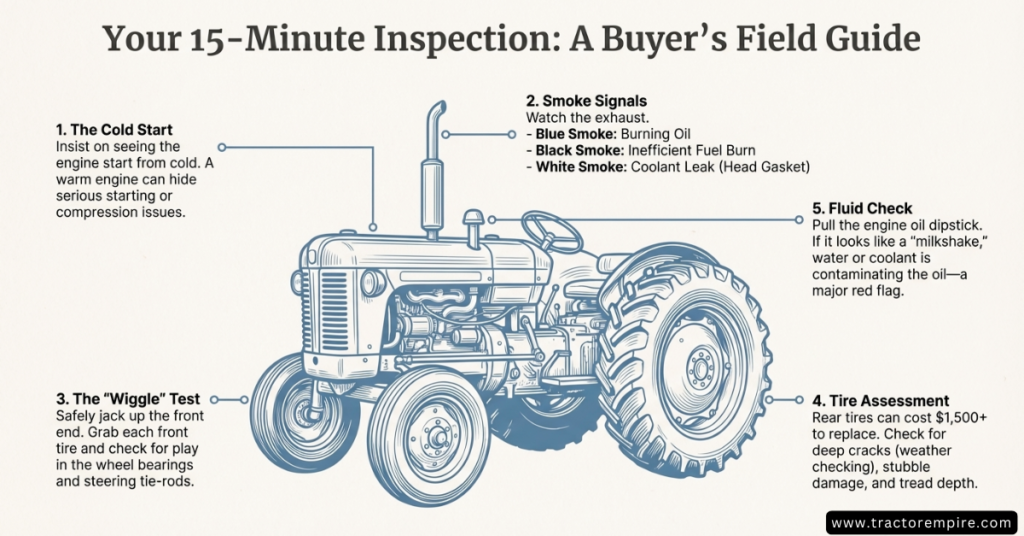
The “Wiggle” Test: Checking Steering and Front End
Grab each front tire at 3 o’clock and 9 o’clock positions. Push and pull vigorously:
- No movement: Excellent
- Slight play (less than 1/4 inch): Acceptable
- Obvious clunking or 1/2+ inch movement: Budget $500-1,200 for tie rod ends, king pins, or bushings
Repeat at 12 o’clock and 6 o’clock to check wheel bearings. Any vertical movement indicates worn bearings ($300-600 to repair).
Tire Assessment: The $1,500 Hidden Cost
Rear tractor tires are shockingly expensive—often $600-800 each for common sizes.
Inspection Points:
- Tread depth: Should be at least 50% remaining for field work
- Age: Check the DOT code on sidewall (should be less than 15 years old)
- Dry rot: Deep cracks in sidewalls mean replacement regardless of tread depth
- Bulges or separations: Immediate safety hazard
Negotiation Strategy: If rear tires need replacement, deduct $1,200-1,500 from asking price. This is a fair, documented expense.
Fluid Check: The “Milkshake” Warning
Pull the engine oil dipstick and check for:
Brown/tan foamy appearance = “Milkshake oil”
- Water contamination from head gasket or cracked block
- Requires immediate attention
- Major red flag—walk away or negotiate heavily
Check transmission and hydraulic fluid similarly. Pink or milky transmission fluid suggests water intrusion.
Quick Operational Tests
Three-Point Hitch:
- Should lift smoothly without jerking
- Should hold position without slowly dropping
- Dropping indicates worn hydraulic pump or cylinders ($800-1,500)
PTO (Power Take-Off):
- Should engage smoothly without grinding
- Check all speeds (540 RPM and 1000 RPM if equipped)
- Excessive vibration suggests bent PTO shaft
Brakes:
- Test each brake independently
- Should stop tractor within 10-15 feet at low speed
- Total brake failure is common on 70+ year-old tractors ($400-800 to rebuild)
Maintenance & Restoration: The Reality Check
Owning a vintage tractor means embracing occasional wrenching. Here’s what you need to know about keeping these machines running.
The 6-Volt vs. 12-Volt Electrical Debate
Original 6-Volt Systems:
- Pros: Historically accurate, satisfies purists, often adequate for seasonal use
- Cons: Weak starting power (especially in cold weather), dim lights, limited accessory options
12-Volt Conversion:
- Pros: Reliable starting, brighter lights, can power modern accessories
- Cons: Costs $200-400, reduces collector value slightly
- Bottom Line: If you’re actually working the tractor, convert to 12V. If it’s a show piece, stay original.
Gas vs. Diesel: Which Fuel Type Should You Buy?
Gasoline Tractors:
- Best For: Parade use, occasional mowing, collectors who value simplicity
- Advantages: Simpler fuel systems, easier cold starting, less maintenance
- Drawbacks: Lower fuel efficiency, less torque for heavy work
Diesel Tractors:
- Best For: Regular field work, bush hogging, sustained heavy use
- Advantages: Better fuel economy, superior torque, longer engine life
- Drawbacks: More complex injection systems, harder to start in cold weather
- Price Premium: Diesel variants typically cost 15-25% more
Straight Talk: If you’re bush hogging more than 5 acres regularly, diesel is mandatory. For everything else, gas is fine and cheaper to buy.
Parts Suppliers: Where to Find What You Need
Yesterday’s Tractors (YT)
- Largest online community and marketplace
- Forums with decades of collective knowledge
- Great for finding used parts and advice
- Website: yesterdaystractors.com
Steiner Tractor Parts
- Comprehensive aftermarket reproduction parts
- Fast shipping, excellent customer service
- Competitive pricing on common items
- Website: steinertractor.com
Messick’s
- Authorized dealer for multiple brands
- Mix of OEM and aftermarket parts
- Excellent educational YouTube channel
- Website: messicks.com
Local Salvage Yards:
- Often overlooked goldmine for rare parts
- Significantly cheaper than new reproductions
- Cash-and-carry, no shipping costs
Realistic Annual Maintenance Costs
For a tractor used 50-100 hours per year:
- Basic maintenance (oil, filters, grease): $150-250/year
- Unexpected repairs (budget conservatively): $300-600/year
- Tires (amortized over 10 years): $150/year
- Total Annual Budget: $600-1,000/year
Tractors used more heavily or those with deferred maintenance can easily double these figures.
Conclusion: Matching the Machine to Your Mission
The “best” vintage tractor isn’t determined by horsepower specs or auction prices—it’s the one that matches your specific needs, budget, and long-term goals.
If you’re a first-time buyer looking for reliable weekend property maintenance, the Ford 8N remains unbeatable. Parts are everywhere, every mechanic knows them, and $4,000 gets you a solid working machine.
If you’re serious about homesteading and need real workhorse capability, invest the extra $2,000-3,000 for a Massey Ferguson 135 diesel. The Perkins engine will outlast you, and the extra horsepower handles everything from bush hogging to hay operations.
If you’re building a collection or treating this as an investment, the John Deere 4020 is as close to a sure thing as vintage iron gets. Values have climbed steadily for 15 years, and there’s no indication that trend will reverse.
If you’re budget-conscious but refuse to compromise on capability, hunt for an Allis-Chalmers WD45 or Oliver 1650. You’ll get 80-90% of the capability for 60-70% of the cost, simply because they aren’t painted green.
Whatever you choose, remember this: vintage tractors reward patience, research, and realistic expectations. They’ll leak oil, require occasional repairs, and demand your attention—but they’ll also connect you to a mechanical heritage that modern equipment can’t replicate.
The right vintage tractor isn’t just a tool or an investment. It’s a partnership with American agricultural history.
What’s your favorite vintage tractor memory? Share your story in the comments below—I read every one.
Frequently Asked Questions
Do vintage tractors need leaded gasoline?
Short answer: No, but there’s nuance.
Tractors built before the mid-1970s were designed for leaded gasoline, which provided valve seat lubrication. However, most vintage tractors ran at lower RPMs and generated less valve seat wear than automobiles.
Your options:
- Do nothing: Most owners run regular unleaded with no issues for occasional use
- Add lead substitute: Products like STA-BIL 360 Marine cost $8-12/bottle and treat 30-40 gallons
- Install hardened valve seats: One-time modification ($400-800) eliminates concerns permanently
Recommendation: For tractors used less than 50 hours annually, regular unleaded is fine. For heavy use or valuable collectibles, install hardened seats during next engine work.
Can I use a vintage tractor for modern bush hogging?
Yes, but with important caveats.
Modern rotary cutters (bush hogs) spin with significant momentum. Older tractors with non-live PTOs (PTO stops when you depress clutch) can experience dangerous kickback when you shift gears or stop suddenly.
Critical Safety Requirement: Install an overrunning clutch (slip clutch) between the tractor PTO and the implement. This $80-150 device allows the implement to safely spin down independently when you disengage the PTO.
Power Recommendations:
- 5-foot bush hog: Minimum 35 HP
- 6-foot bush hog: Minimum 45 HP
- 7-foot bush hog: Minimum 55 HP
Never operate undersized—this causes dangerous overheating and premature wear.
Which vintage tractor holds its value best?
The John Deere 4020 is the undisputed champion of value retention.
Over the past 15 years, quality 4020s have appreciated 40-60%, outperforming many traditional investments. Factors driving this:
- Universal recognition: Everyone knows the 4020
- High demand: Baby boomers with disposal income seeking nostalgia
- Actual utility: Still capable of real farm work
- Parts availability: You can rebuild one completely with aftermarket parts
Runner-up: Farmall M/Super M models offer stable values and affordable entry points, though appreciation is slower.
Dark horse: Allis-Chalmers WD45 and WD models are appreciating faster than most realize as collectors discover their value proposition.
What’s the difference between “restored” and “rebuilt”?
Rebuilt = Mechanically Sound
- Engine, transmission, and hydraulics overhauled
- Functional but may have cosmetic imperfections
- Focus on reliability and utility
- Typically 30-40% less expensive than restored
Restored = Show Quality
- Complete cosmetic and mechanical refurbishment
- Often better than original factory condition
- Correct paint codes, decals, and hardware
- Commands premium prices
Best Value: Find a well-maintained original or mechanically rebuilt tractor. Over-restored show tractors often don’t appreciate proportionally to restoration costs.
Should I buy a tractor with a loader already installed?
Depends on your needs, but generally yes—if you need a loader.
Factory or dealer-installed loaders are far superior to aftermarket bolt-on kits. They’re engineered for specific tractor frames and hydraulic systems.
Loader Benefits:
- Material handling (gravel, dirt, manure)
- Snow removal
- General property maintenance
- Adds $1,500-3,000 to tractor value
Loader Drawbacks:
- Reduces visibility
- Limits three-point hitch access
- Can stress front axle and steering components
Bottom line: A tractor with a well-matched loader is worth the premium if property maintenance is your primary goal.
What is the most popular old tractor?
The Ford 8N is the most popular vintage tractor in America, with over 500,000 units produced between 1947-1952. Its widespread availability, simple design, and unmatched parts support make it the go-to choice for first-time buyers and homesteaders. The John Deere 4020 runs a close second among collectors due to its iconic status and strong appreciation potential.
What tractor has the least problems?
The Massey Ferguson 135 with the Perkins AD3.152 diesel engine is legendary for reliability. Owners regularly report 10,000+ hours with just basic maintenance. The three-cylinder British engine is incredibly simple, fuel-efficient, and nearly bulletproof. For pure mechanical simplicity, the Ford 8N also ranks extremely high—there’s just less to go wrong on these straightforward machines.
What is the best antique pulling tractor?
For competitive tractor pulling, the Farmall M and Super M dominate the vintage classes. Their row-crop design provides excellent weight distribution, and the engine responds well to performance modifications. The John Deere Model A is another pulling favorite due to its robust two-cylinder engine and strong aftermarket performance parts availability. Both offer the power and durability needed for the extreme stress of pulling competitions.