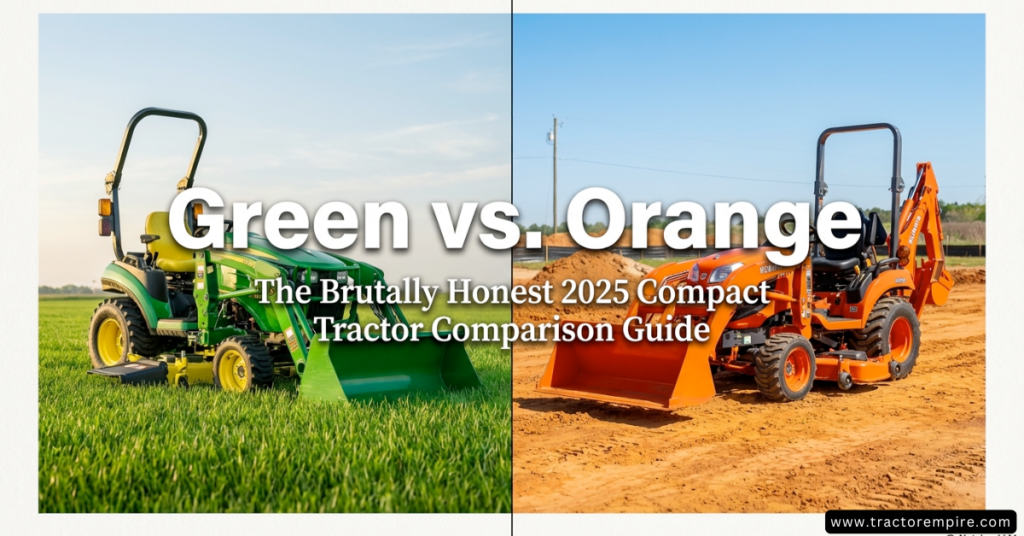
If you’ve spent any time on tractor forums, you know this debate gets heated. The “green vs. orange” rivalry between John Deere and Kubota compact tractors is the agricultural equivalent of Ford vs. Chevy and everyone has an opinion.
Here’s the problem: most comparison articles you’ll find online are written by dealers who want to sell you their brand. They’ll cherry-pick specifications and gloss over real-world issues that only show up after you’ve owned a tractor for a few years.
This guide is different. I’m going to walk you through the engineering philosophies, ergonomic differences, and long-term ownership costs of both brands so you can make an informed decision based on your specific needs, not what some dealer thinks you should buy.
Key Takeaways
- Kubota typically offers 5-10% better value upfront with metal construction
- John Deere excels at mowing with its AutoConnect deck system
- Pedal design (Twin Touch vs. Treadle) is the #1 reason buyers choose one brand over the other
- Your local dealer network matters more than paint color
- Both brands hold excellent resale value in the used market
- Brand Philosophy: Two Different Approaches to the Same Problem
- The Ergonomics Battle: Why Pedal Design Matters More Than You Think
- Head-to-Head Series Breakdown: Finding Your Match
- Ownership Reality: What Happens After You Buy
- Financial Analysis: The True Cost Comparison
- The Verdict: Decision Framework for Real-World Buyers
- Choosing the Right Compact Tractor: Final Thoughts
- Frequently Asked Questions
Brand Philosophy: Two Different Approaches to the Same Problem
Understanding how John Deere and Kubota approach tractor design will help you predict which machine will fit your working style.
John Deere: The “Apple” Approach
John Deere has positioned itself as the premium experience brand. They focus on refined user interfaces, comfort features, and seamless integration between attachments. Think of them as the Apple of the tractor world—everything works together beautifully, but you’re often locked into their ecosystem.
Their proprietary systems like AutoConnect™ drive-over mower decks and Quick-Park™ loaders are legitimately the easiest attachment systems on the market. I can connect a mower deck in under 30 seconds without leaving the seat, and that convenience adds up when you’re mowing weekly.
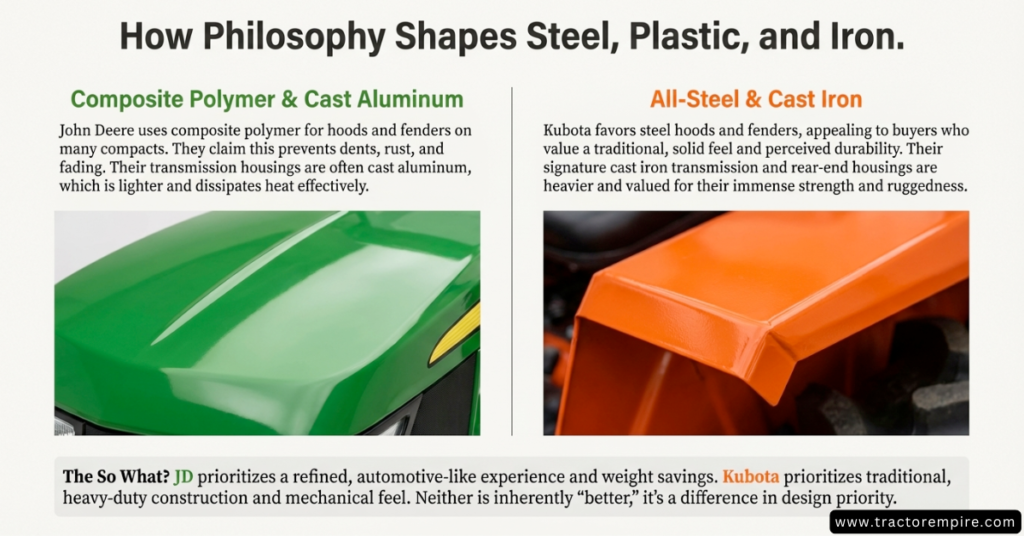
John Deere also makes extensive use of composite polymer (what most people call “plastic”) hoods and fender panels. Their marketing claims these won’t dent, rust, or fade. In practice? They’re incredibly durable, but some buyers just don’t like the aesthetic. It doesn’t feel like a traditional tractor when you knock on it.
Kubota: The “Android/PC” Approach
Kubota takes a different philosophy. They prioritize mechanical simplicity, durability, and standardization. Their tractors adhere more strictly to universal standards like SSQA (Skid Steer Quick Attach) across more product lines, which means third-party attachments generally fit without adapters.
You’ll find metal hoods and fenders on Kubota tractors. It feels solid and traditional, more like what your grandfather’s tractor felt like. This construction approach resonates with buyers who plan to keep their tractor for decades.
Kubota’s tractors are also generally more DIY-friendly. There are fewer software locks, and independent mechanics can service them without dealer-only diagnostic tools. If you’re the type who wants to do your own oil changes and maintenance, Kubota makes that easier.
The Transmission Case Debate: Cast Iron vs. Cast Aluminum
This technical difference gets a lot of attention in online debates, so let’s address it objectively.
Kubota uses cast iron transmission cases across most of their lineup. Cast iron is heavier and provides excellent heat dissipation, which can extend transmission life in demanding applications. It’s also incredibly durable, virtually impossible to crack under normal use.
John Deere uses cast aluminum in their sub-compact and many compact models. Aluminum is lighter, which improves fuel efficiency and reduces ground compaction. It also doesn’t rust. The heat dissipation argument favoring iron is real, but in practice, John Deere’s aluminum cases are engineered with fins and design features that manage heat effectively.
Which is better? It depends on your priorities. If you’re doing heavy loader work in hot climates for hours daily, cast iron’s thermal properties might matter. For most homeowners and hobby farmers, both materials perform excellently over the tractor’s lifetime.
The Ergonomics Battle: Why Pedal Design Matters More Than You Think
Here’s something most comparison articles won’t tell you: the ergonomics of the operator station, specifically the pedal layout is the single biggest reason people choose one brand over the other. This matters way more than a half-horsepower difference in the specs.
John Deere’s Twin Touch™ Pedal System
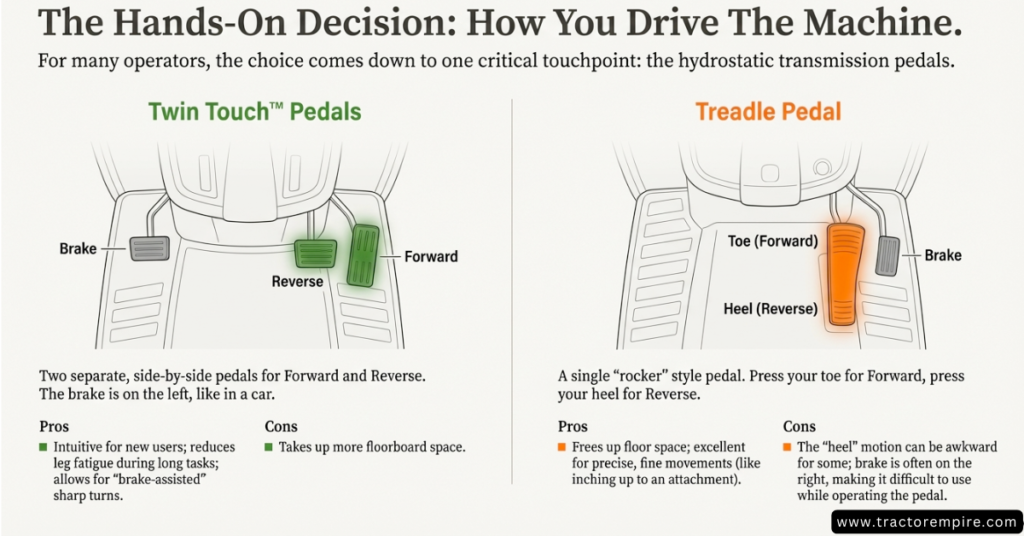
John Deere uses two side-by-side pedals positioned on the right side of the platform. The right pedal controls forward motion, and the left pedal controls reverse. There’s a separate brake pedal on the left side of the platform.
- Incredibly intuitive for anyone who’s driven a car
- Reduces leg fatigue because you can alternate feet
- The left-side brake can be used while driving for tight turns
- More floorboard space works better if you have large feet or wear work boots
- Takes up more floor space overall
- Can feel cramped if you’re short or prefer sitting closer to the wheel
I’ve logged hundreds of hours on Twin Touch pedals, and they’re genuinely comfortable. The natural forward and back motion feels easier on my knees compared to the ankle-pivot motion required by Kubota’s system.
Kubota’s Treadle Pedal System
Kubota uses a single “rocker” pedal. You press your toe forward for forward motion and rock your heel back for reverse. The brake is typically a separate pedal on the right side.
- Frees up significant floor space, which matters in compact operator stations
- Allows extremely fine control for precise movements when loader work demands incremental adjustments
- Some operators find it reduces fatigue once they adapt to it
- The heel-back motion can be uncomfortable if you have limited ankle mobility or knee issues
- The brake location on the right makes it harder to brake while moving (you need to take your foot off the treadle)
- Steeper learning curve if you’re coming from automotive experience
Here’s my honest take: if you test-drive both and one pedal system immediately feels better, trust that feeling. You’ll spend hundreds of hours operating this machine, and comfort matters.
Head-to-Head Series Breakdown: Finding Your Match
Let’s compare the actual tractors you’ll find at dealerships. I’ve organized this by size category because comparing a sub-compact to a utility tractor makes no sense.
Round 1: Sub-Compact Tractors (The “Mower-First” Category)
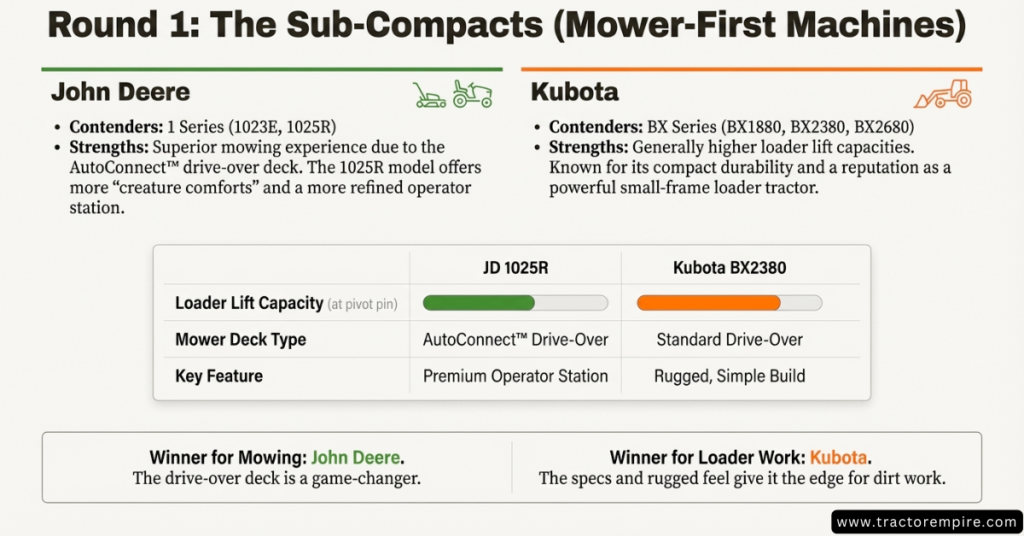
Contenders: John Deere 1 Series (1023E, 1025R) vs. Kubota BX Series (BX1880, BX2380, BX2680)
Sub-compact tractors ranging from 23.9 to 36.7 engine horsepower are designed primarily for mowing with light loader work as a secondary function. Think of these as riding mowers with actual tractor capabilities.
Winner for Mowing: John Deere, no contest. The AutoConnect drive-over deck is genuinely revolutionary. You position the tractor over the deck, lower the connection arm, and you’re done in 20 seconds. Kubota’s BX mower attachment process involves crawling under the tractor with pins and clevis fasteners. After doing both for a season, the JD system saves meaningful time.
Winner for Loader Work: Kubota BX series. The BX2680 offers higher loader lift capacity at the pivot pins compared to the 1025R. If you’re moving heavy materials regularly, Kubota gives you more capability in the same size package.
The Real Differentiator: The John Deere 1025R comes with more creature comforts—better seat padding, slightly quieter operation, nicer control layout. The Kubota BX focuses on compact durability and mechanical simplicity. Like the kubota? You’ll appreciate spending less upfront while getting a workhorse that’s easier to maintain yourself.
Verdict: Buy John Deere if mowing is your primary task. Buy Kubota if you need a compact utility tractor that can mow occasionally.
Round 2: Small Frame Compact Tractors (The “Estate” Category)
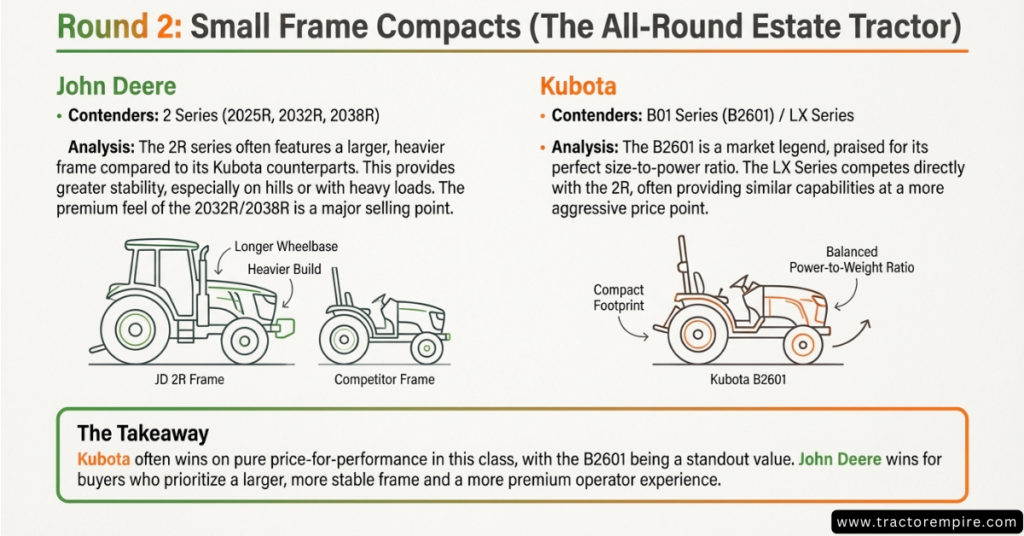
Contenders: John Deere 2 Series (2025R, 2032R, 2038R) vs. Kubota B01 Series / LX Series
This category represents the most popular compact utility tractor segment for property owners with 5-20 acres.
The Kubota B2601 has become a market favorite because it offers an exceptional size-to-power ratio. It’s legitimately compact (fits through most gates) while delivering meaningful work capacity. Kubota’s B01 series tractors come standard with features that John Deere charges extra for, which improves the value proposition.
The John Deere 2038R is positioned as a “large” compact with a much bigger footprint than comparable Kubota models. It’s more stable on slopes and handles heavier implements, but it won’t fit through narrow gates or maneuver in tight spaces as easily.
Verdict: Kubota often wins on price-per-feature in this category. You’ll typically save 5-10% compared to a similarly equipped John Deere. However, JD wins on stability and overall frame size if you’re working hillsides or need maximum implement capacity.
Round 3: Utility & Heavy Compact Tractors (The Serious Work Category)
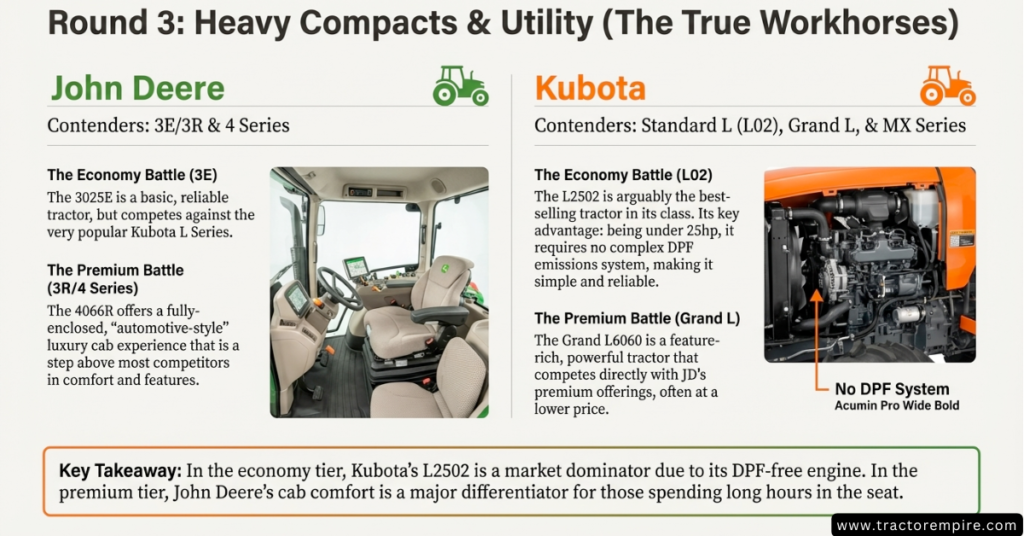
Contenders: John Deere 3E/3R Series & 4 Series vs. Kubota L02 (Standard L Series) & Grand L / MX Series
This is where things get interesting because we’re talking about real work tractors that can handle commercial-level tasks.
The Economy Battle: John Deere 3025E vs. Kubota L2502
The Kubota L2502 is arguably the best-selling tractor in this horsepower class, and for good reason. It delivers 25 horsepower with no DPF (Diesel Particulate Filter) required, which means no DEF fluid, no forced regeneration cycles, and simpler maintenance. The 3025E from John Deere is a solid machine, but it includes emissions equipment that adds complexity.
If you’re a tractor owner who wants minimal maintenance hassle, the L2502’s simplicity is compelling. However, the JD 3025E offers better hydraulics and smoother operation overall.
The Premium Battle: John Deere 4066R vs. Kubota Grand L6060
At the high end, John Deere’s 4 series tractors offer a more automotive-like cab experience with better climate control, noise insulation, and premium seating. The Grand L6060 from Kubota delivers comparable power and hydraulic performance at a lower new price point while maintaining excellent build quality.
Verdict: If cost of ownership matters more than upfront price, both brands perform excellently. John Deere provides marginally better refinement; Kubota provides better initial value. Your specific dealer’s service quality will matter more than the badge.
Ownership Reality: What Happens After You Buy
The purchase price is just the beginning. Let’s talk about what actually affects your wallet and schedule over 10+ years of ownership.
DPF & Emissions: The Under-25HP Sweet Spot
Here’s something dealers don’t always explain clearly: tractors under 25 horsepower generally don’t require DPF systems or DEF (Diesel Exhaust Fluid). This matters because DPF regeneration cycles can be inconvenient, and DEF is an ongoing expense.
Both John Deere and Kubota offer models just under this threshold (like the L2501 and 3025E) that avoid these complications. If you can accomplish your tasks with 24-25 horsepower, you’ll save money and headaches.
For models above 25HP that do have emissions equipment, Kubota’s regeneration cycles have a reputation for being less problematic in real-world use. John Deere’s systems work well when operated according to the manual, but they’re less forgiving if you primarily do short-duration tasks that don’t allow complete regen cycles.
Right to Repair: The DIY Difference
This is a significant consideration if you plan to do your own maintenance.
Kubota tractors are generally more DIY-friendly. You can change fluids, filters, and perform routine maintenance without proprietary tools or software. Third-party mechanics can service them without dealer-only diagnostic equipment. If you bought a Kubota and your dealer closes, you have options.
John Deere has better onboard diagnostics with more sophisticated error codes, but accessing many of those codes requires dealer software. Some repairs that seem simple like replacing certain sensors may require a dealer visit to clear error codes or recalibrate systems. JD is improving in this area, but they’re still more restrictive than Kubota.
If you’re mechanically inclined and want to handle your own maintenance, Kubota’s approach will save you money and give you more control.
The Dealer Network: Buy the Dealer, Not the Tractor
I cannot stress this enough: the quality of your local dealer matters more than the color of the tractor.
A great Kubota dealer will provide better ownership experience than a mediocre John Deere dealer, and vice versa. Before you decide, visit both dealerships in your area. Ask these questions:
- How quickly can you get service appointments?
- Do they offer loaner equipment during repairs?
- What’s their parts inventory like for common maintenance items?
- How far will they travel for on-site service calls?
If your nearest John Deere dealer is 60 miles away but you have an excellent Kubota dealer 15 minutes down the road, that geography should heavily influence your decision. Conversely, if your local JD dealer has a stellar reputation and quick turnaround times, that convenience has real value.
| Related: Best Lawn Tractor 2026: Expert Reviews & Buying Guide
Financial Analysis: The True Cost Comparison
Let’s cut through the marketing and look at real numbers.
Upfront Cost: Kubota’s Value Advantage
On average, Kubota offers 5-10% better value for comparable specifications. A similarly equipped Kubota will typically cost $1,500-$3,500 less than the John Deere equivalent, depending on the size category.
However, “similarly equipped” is doing a lot of work in that sentence. John Deere often includes features as standard that Kubota charges extra for, and vice versa. You need to compare actual delivered prices with identical features, not base MSRP.
Financing: The Zero-Percent Game
Both manufacturers frequently offer 0% financing promotions. Here’s what to watch for:
- John Deere Financial typically offers cleaner 0% deals with fewer hidden fees
- Kubota’s 0% financing often requires purchasing additional insurance products that add $500-$1,000 to the total cost
- Both brands may limit 0% offers to specific models or require shorter loan terms
Always calculate the total amount financed, including all fees, to compare true costs.
Resale Value: Green Holds an Edge
Both brands maintain excellent resale value compared to competitors like New Holland or Yanmar. However, John Deere has a slight advantage in the used market, typically holding 5-10% more value after 5-10 years.
This advantage comes from brand recognition. More buyers search specifically for “used John Deere tractors,” which creates stronger demand. An older Kubota with lower hours might be the better mechanical deal, but it may take longer to sell.
If you plan to keep your tractor for 15+ years, resale value becomes less relevant. But if you upgrade every 5-7 years, John Deere’s stronger resale value can offset the higher purchase price.
The Verdict: Decision Framework for Real-World Buyers
Let me give you a decision guide based on actual usage patterns, not just specifications.
- Your primary task is mowing. The AutoConnect deck system is genuinely superior, and if you’re mowing multiple acres weekly, the time savings add up to dozens of hours per year.
- You are tall or have large feet. The Twin Touch pedal system provides more room for operators over 6 feet or those who wear size 12+ work boots. Comfort matters when you’re spending 3-4 hours on the machine.
- You want the easiest attachment swapping. iMatch and Quick-Park systems are the most user-friendly on the market. If you frequently switch between loader, mower, and implements, JD’s design reduces frustration.
- You have a local John Deere dealer within 20 minutes. Proximity to quality service trumps almost everything else for long-term satisfaction.
- You value refinement and user experience. If you appreciate thoughtful design details and a more “automotive” operating experience, John Deere delivers.
- You’re doing mostly dirt work or loader work. Kubota’s hydraulics provide excellent feel and responsiveness for loader operations. Their compact utility tractors often deliver higher lift capacity in the same size class.
- You want a metal tractor. If the look and feel of traditional steel construction matters to you, Kubota delivers that aesthetic and durability.
- You plan to do your own maintenance. Kubota’s simpler systems and lack of software restrictions make DIY maintenance easier and cheaper.
- You want to save ~10% upfront without sacrificing quality. Kubota models typically offer better initial value while maintaining excellent build quality and performance.
- You have a strong local Kubota dealer. Just like with John Deere, excellent local support makes ownership dramatically better.
Choosing the Right Compact Tractor: Final Thoughts
The Kubota vs. John Deere debate will continue as long as both companies make tractors. Online forums will argue endlessly about transmission cases, hydraulic systems, and which green and orange tractors are superior.
Here’s the truth: both brands build excellent compact utility tractors. You’re not making a bad choice with either one—you’re choosing which engineering philosophy and ecosystem fits your specific needs better.
The kubotas excel at delivering mechanical simplicity and value. The deere equipment excels at user experience and integrated systems. Both tractors are built to last decades with proper maintenance.
Your decision should prioritize:
- Your primary task (mowing vs. loader work vs. mixed use)
- Your local dealer quality (service matters more than specs)
- Your comfort with the ergonomics (test drive both pedal systems)
- Your maintenance preferences (DIY vs. dealer service)
- Your budget reality (total cost of ownership over 10 years)
Visit your local dealers, operate both brands, and trust your gut. The “best” tractor is the one that makes your work easier and more enjoyable regardless of whether it’s green or orange.
Frequently Asked Questions
Are plastic hoods on John Deere tractors bad?
No, they’re not “bad”—they’re just different. John Deere’s composite polymer body panels are extremely durable and won’t dent, rust, or fade like metal can. However, they don’t have the traditional “solid” feel of metal, which bothers some buyers. In terms of functionality and longevity, they perform excellently. It’s an aesthetic preference, not a quality issue.
Which tractor is better for snow removal: Kubota or John Deere?
Both brands handle snow removal well with proper equipment (4WD, tire chains, appropriate blade or blower). The deciding factors are weight distribution and traction, which depend more on your specific model and setup than the brand. That said, Kubota’s lower center of gravity in some models provides slightly better stability on icy slopes, while John Deere’s slightly heavier build can improve pushing power with blade attachments.
Do Kubota tractors hold their value as well as John Deere?
Kubota tractors hold excellent resale value—among the best in the industry. John Deere typically maintains a 5-10% edge in used market value due to stronger brand recognition and broader buyer demand. However, both brands dramatically outperform competitors like Ford tractor models, Yanmar, or economy brands. If you maintain either brand properly, you’ll get strong resale returns.
Is the treadle pedal hard to get used to?
It depends on your physical flexibility and previous experience. Most operators adapt within 5-10 hours of use. However, if you have limited ankle mobility, knee issues, or simply find the rocking motion uncomfortable during your test drive, trust that feeling—it probably won’t get significantly more comfortable. The twin touch system is more intuitive for most people coming from automotive experience.
Which brand offers better tractors for small acreage (5-10 acres)?
For small acreage work, both deere and kubota tractors offer excellent options. The John Deere 1-series or 2-series and the Kubota BX series or B01 series are specifically designed for this market. Your decision should focus on whether mowing (favors JD) or loader work (favors Kubota) dominates your task list, along with which dealer provides better local support.
What about New Holland or Yanmar tractors?
New Holland builds solid tractors, particularly in the utility segment, but their compact tractor lineup is smaller and their dealer network is less extensive in most regions. Yanmar manufactures excellent engines (both deere makes and Kubota use Yanmar engines in some models) and builds quality tractors, but their U.S. dealer presence is limited. For most buyers, the stronger dealer networks of John Deere or Kubota provide better long-term value.