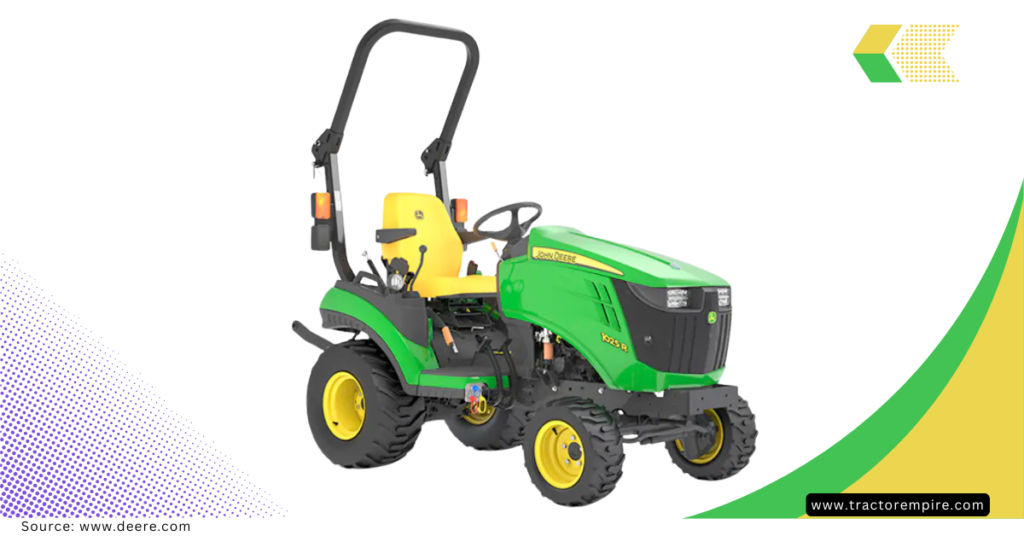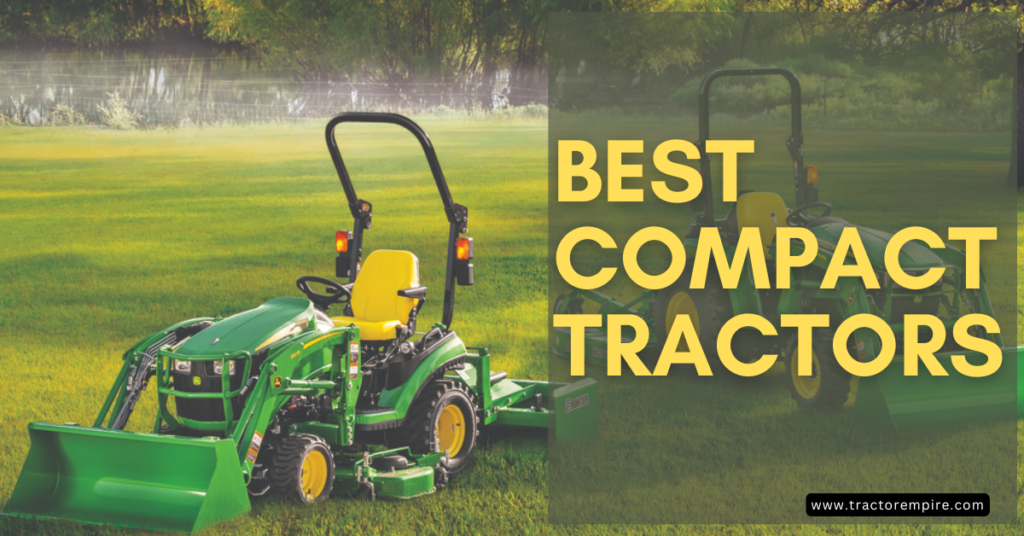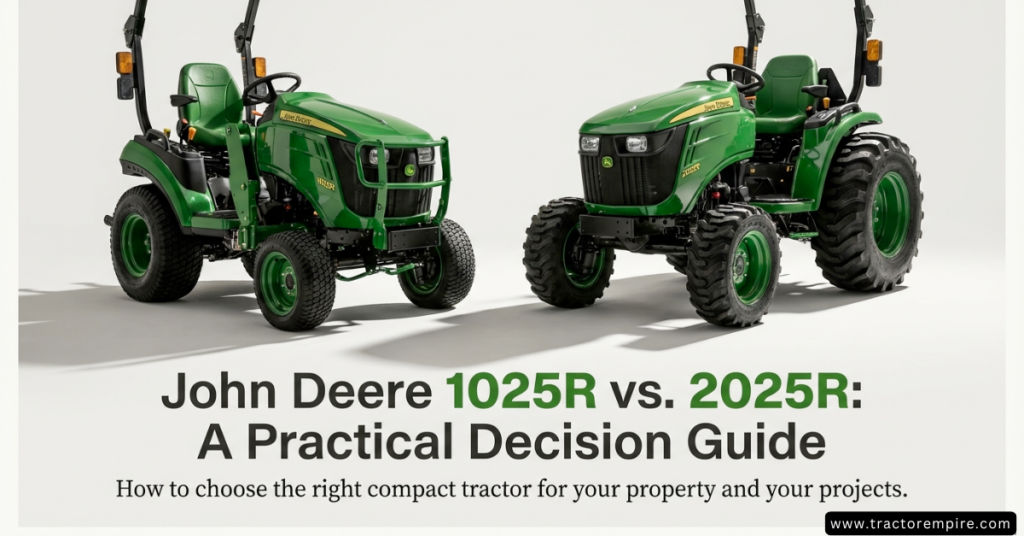
If you’re shopping for a John Deere compact utility tractor, you’ve probably found yourself comparing the John Deere 1025R vs 2025R. I get it, these two tractors look nearly identical at first glance, and the price difference isn’t huge. So what exactly separates them, and which one should you buy?
I’ve spent considerable time analyzing both models, talking with JD dealers, and reviewing feedback from actual tractor owners and enthusiasts. Here’s the honest truth: the differences are subtle but meaningful, and choosing the wrong one could mean paying for capabilities you’ll never use or worse, struggling with a machine that can’t quite handle your property’s demands.
Key Takeaways
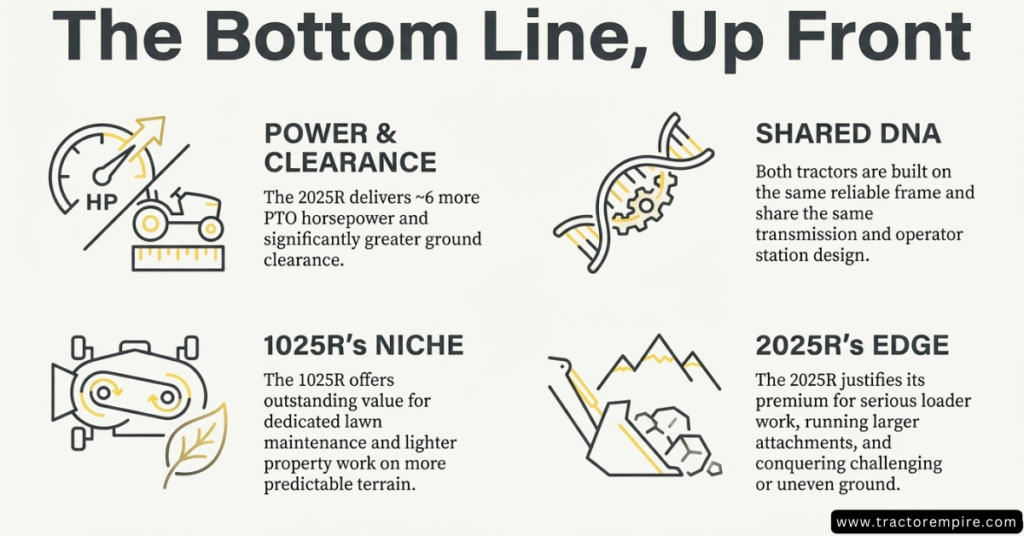
- The 2025R offers 6 more horsepower and greater ground clearance than the 1025R
- Both tractors share the same frame, transmission, and operator station design
- The 1025R provides better value for lawn maintenance and light property work
- The 2025R justifies its premium for loader work, larger attachments, and challenging terrain
- Your decision should hinge on ground conditions and primary use cases, not just acreage
- John Deere 1025R vs 2025R: Quick Comparison
- Understanding the Power Difference
- Ground Clearance and Terrain Capability
- Loader Performance and Lifting Capacity
- Mowing Performance and Deck Options
- Attachment Versatility and Compatibility
- Operating Costs and Value Comparison
- Size, Maneuverability, and Storage
- Hydraulic Systems and Performance
- Making Your Decision: Which Tractor Fits Your Needs?
- Comparable Alternatives Worth Considering
- Final Verdict: Choosing Your Compact Tractor
- Frequently Asked Questions
John Deere 1025R vs 2025R: Quick Comparison
Before we dive deep, let’s establish the fundamental differences between the John Deere 1025R and 2025R. While these two compact tractors share more similarities than differences, those distinctions matter significantly depending on what you need to accomplish.
John Deere 1025R
Engine Power
24.2 HP / 18 PTO HP
Ground Clearance
7.9 inches
Tire Size (Rear)
26×12-12
Operating Weight
1,611 lbs
Wheelbase
56.1 inches
Loader Lift Capacity
683 lbs (120R)
Starting Price
$18,000-$20,000
John Deere 2025R
Engine Power
24.7 HP / 23.9 PTO HP
Ground Clearance
9.2 inches
Tire Size (Rear)
29×14-16
Operating Weight
1,807 lbs
Wheelbase
60.2 inches
Loader Lift Capacity
838 lbs (120R)
Starting Price
$22,000-$24,000
Both tractors feature hydrostatic transmission, 4WD capability, and Category 1 three-point hitch systems. They’re built on similar platforms by Yanmar and share John Deere’s excellent reputation for reliability in the 2 Series compact utility line.
Understanding the Power Difference
Engine Performance: More Than Just Numbers
Here’s where things get interesting. On paper, the 1025R and 2025R show minimal difference in total horsepower, we’re talking about half a horsepower. But the PTO horsepower tells a completely different story.
The 1025R delivers 18 pto horsepower, which handles most mowing, tilling, and light implement work without breaking a sweat. For typical lawn and garden tractor tasks on small acreage properties (1-5 acres), you’ll rarely push it to its limits.
The 2025R is rated at 23.9 PTO HP—that’s roughly 33% more power to your implements. This matters tremendously when you’re running a rotary cutter through thick brush, operating a wood chipper, or powering a heavy-duty tiller through compacted soil. The additional weight and larger tires also mean this extra power translates to real-world pulling and lifting performance.
When the Extra Horsepower Actually Matters
I’ll be straight with you: most homeowners won’t fully utilize the 2025R’s power advantage. If your typical weekend involves mowing three acres of established lawn and moving some mulch with the loader, the 1025R has you covered.
The 2025R shines when you’re:
- Clearing overgrown property with dense vegetation
- Operating a brushcutter or flail mower through tough material
- Running a backhoe attachment for serious digging projects
- Pulling heavy implements through clay or rocky soil
- Working slopes where additional ballast and power provide crucial traction
Think of it this way: the 1025R is a capable daily driver, while the 2025R is that same vehicle with an upgraded towing package and off-road suspension.
Ground Clearance and Terrain Capability
The 1.3-Inch Difference That Changes Everything
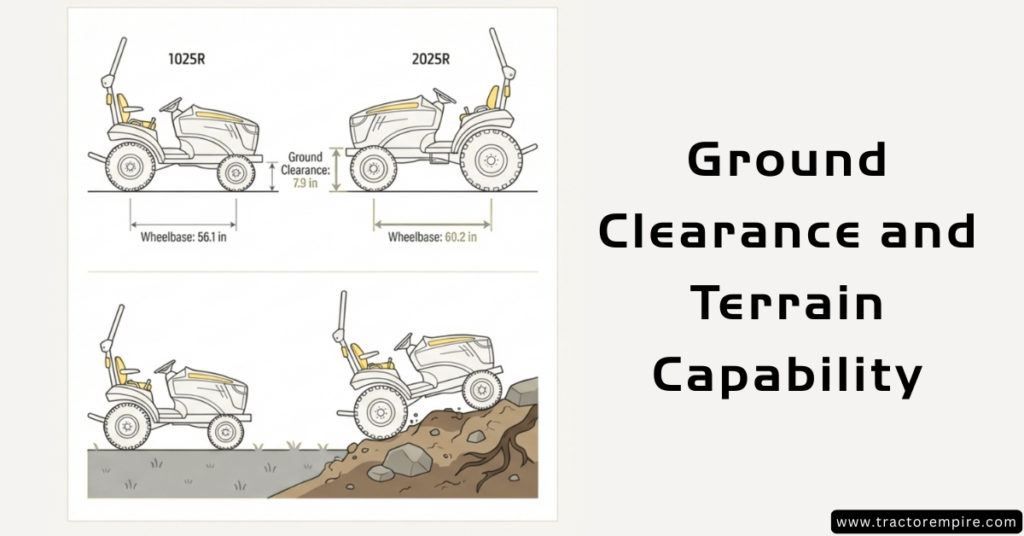
Higher ground clearance on the 2025r—9.2 inches versus the 1025R’s 7.9 inches—might seem trivial. It’s not. This represents roughly 16% more clearance, and that transforms how each tractor navigates challenging terrain.
On flat, maintained lawns, you’ll never notice this difference. But venture into areas with ruts, rocks, or uneven ground, and that extra clearance becomes crucial. I’ve heard from compact tractor owners who scraped the 1025R’s belly pan on modest terrain features that the 2025R cleared effortlessly.
The larger tires on the 2025R (29×14-16 rear tires versus 26×12-12) contribute significantly to this advantage. They not only raise the chassis but also provide:
- Better weight distribution across softer ground
- Improved traction in muddy or loose conditions
- Reduced soil compaction when working gardens or sensitive areas
- Enhanced stability on slopes and sidehills
Real-World Terrain Scenarios
When the 1025R handles terrain perfectly:
- Established lawns with minimal obstacles
- Gentle slopes under 10 degrees
- Well-maintained trails and pathways
- Properties with existing infrastructure (gravel drives, cleared work areas)
When the 2025R’s advantages become critical:
- Properties with significant rocks, stumps, or debris
- Steep slopes requiring ballast and stability
- Muddy or wet conditions where traction is compromised
- Creek crossings or drainage ditches
- Unimproved land being cleared for the first time
One John Deere dealer put it simply: “If your property looks like a suburban yard, get the 1025. If it looks like farmland or raw acreage, the 2025r comparison tips toward the larger machine.”
Loader Performance and Lifting Capacity
Understanding FEL Capabilities
Both the 1025r and 2025r can accommodate the same 120R loader, but the 2025R comes with distinct advantages that translate to superior loader work performance.
The extra lift capacity—838 pounds on the 2025R versus 683 pounds on the 1025R—represents a 23% improvement. That’s the difference between comfortably lifting a half-yard scoop of gravel versus struggling with the same load.
More importantly, the additional weight of the 2025R (196 pounds heavier) provides natural ballast when the end loader is carrying material. This heavier weight means:
- Better stability with full bucket loads
- Reduced likelihood of the rear wheels lifting during aggressive loader work
- Improved ability to “power through” material when filling the bucket
- Less need for additional ballast in typical operations
Practical Loader Applications
For most homeowners doing occasional loader work—moving mulch, relocating gravel, clearing snow—the 1025R performs admirably. You’ll just need to be more conscious about load sizes and may require rear ballast for heavier tasks.
The 2025R justifies its premium if you regularly:
- Move landscape materials (stone, dirt, compost) in bulk
- Grade and level areas requiring multiple bucket passes
- Load trucks or trailers with dense materials
- Work with wet, heavy soil or clay
- Operate in conditions where stability is paramount
I’ve talked with owners who bought a 2025r specifically after experiencing the 1025R’s limitations with a fel during construction projects. The consensus? If loader work represents more than 25% of your tractor use, seriously consider the upgraded capacity.
| Related: Best Tractor for Small Farm: 2026 Buyer’s Guide & Reviews
Mowing Performance and Deck Options
Mower Deck Compatibility
Here’s good news: both tractors accommodate the same mower deck options, so your mowing capabilities aren’t directly limited by choosing one model over the other. John Deere offers 54-inch and 60-inch AutoConnect mower deck options for both the 1025r and 2025r.
However, deck height and cutting performance differ based on each tractor’s characteristics. The greater ground clearance on the 2025R allows for higher mower deck height settings, which helps when navigating:
- Uneven terrain with bumps or rises
- Properties with surface roots or stones
- Transitional areas between lawn and rougher ground
The 1025R’s lower profile actually provides advantages for finish mowing on flat lawns. The reduced clearance helps maintain consistent deck height over smooth terrain, potentially delivering a more uniform cut on groomed properties.
Mowing Across Different Property Types
Ideal mowing scenarios for each model:
The 1025R excels at:
- Residential lawn maintenance with established grass
- Properties under 3 acres of maintained turf
- Terrain with minimal obstacles or elevation changes
- Situations where maneuverability matters more than raw power
The 2025R handles all the above plus:
- Rough-cut mowing in overgrown areas
- Properties with varied terrain requiring frequent deck height changes
- Transitioning between lawn areas and field/pasture mowing
- Thick, tall grass where additional PTO power prevents bogging
If you primarily mow and only occasionally use other attachments, the 1025R likely provides better value. The 2025R makes sense when mowing is just one of many demanding tasks.
Attachment Versatility and Compatibility
Three-Point Hitch Capabilities
Both tractors feature Category 1 three-point hitch systems with comparable lift capacity—roughly 765 pounds for the 1025R and 837 pounds for the 2025R. This means most common compact tractor attachments work with either model.
The real differentiation comes from how effectively each tractor powers and controls those attachments in actual use. The 2025R’s additional PTO horsepower translates to:
- Better performance with rotary cutters in dense brush
- Improved capability with tillers and cultivators in heavy soil
- More consistent operation of powered attachments under load
- Reduced strain on the hydrostatic transmission during demanding tasks
Common Attachment Considerations
Attachments where both tractors perform equally well:
- Box blades and grading equipment
- Post hole diggers (6-9 inch augers)
- Seeders and spreaders
- Light-duty tillers for established gardens
- Landscape rakes
Attachments that benefit significantly from the 2025R’s capabilities:
- Heavy-duty rotary cutters (5-foot and wider)
- Commercial-grade tillers for breaking new ground
- Wood chippers requiring sustained PTO power
- Backhoe attachments for serious excavation
- Large post hole diggers (12-inch+ augers)
One experienced compact tractor owner shared this perspective: “I bought the 1025R thinking I’d save money and upgrade attachments later. Turns out I was maxing out the tractor’s capability, not the attachment’s. Should’ve bought the 2025R from the start.”
Operating Costs and Value Comparison
Initial Investment vs. Long-Term Value
The price gap between these two compact tractors typically runs $3,000-$5,000 depending on your John Deere dealer and current promotions. Let’s talk about whether that premium makes financial sense.
The 1025R represents exceptional value if:
- Your needs genuinely align with its capabilities
- You’re working with a fixed budget and can’t stretch further
- Future expansion of property or tasks seems unlikely
- Resale value and initial cost matter more than maximum capability
The 2025R justifies the additional investment when:
- You anticipate property development or expansion
- Current tasks occasionally push equipment limits
- You value having capability headroom for unexpected projects
- You’re replacing a larger tractor and want to minimize capability compromise
Maintenance and Operating Expenses
Here’s welcome news: maintenance costs between the 1025r and the 2025r are nearly identical. Both use the same:
- Oil and filter capacities
- Air filtration systems
- Fuel consumption rates (minimal difference)
- Service intervals and procedures
- Common wear items (belts, fluids, filters)
The 2025R’s larger rear tires represent the primary ongoing cost difference—replacement tire costs run about $100-150 more per set. However, those tires typically last longer under comparable use conditions due to their larger footprint and reduced stress per square inch.
Insurance, if you carry it, may run marginally higher for the 2025R given its greater value. We’re talking maybe $50-75 annually in most cases—not a deal-breaker.
Size, Maneuverability, and Storage
Physical Dimensions Comparison
The 2025R’s longer wheelbase (60.2 inches versus 56.1 inches) and larger overall footprint affect maneuverability in tight spaces. This matters more than you might think if you’re navigating between buildings, around landscaping, or working in established garden areas.
The frame as the 1025R foundation remains similar on both models, but the 2025R is built with:
- Approximately 4 inches additional wheelbase length
- Wider turning radius due to larger rear tires
- Slightly greater overall width when comparing similar configurations
For properties with tight access points—narrow gates, between-building passages, or established landscape beds—the 1025R’s more compact dimensions provide meaningful advantages.
Storage and Transport Considerations
Both tractors fit comfortably on standard equipment trailers and in typical outbuilding spaces. However, if you’re working with minimal clearances, note these dimensions:
The 1025R (without loader):
- Length: Approximately 99 inches
- Width: Approximately 47 inches (varies with tire options)
- Height: Approximately 85 inches (ROPS up)
The 2025R shows similar measurements but adds several inches in each dimension depending on configuration. More importantly, the additional weight impacts:
- Trailer capacity requirements for transport
- Floor loading if storing in older buildings
- Ramp requirements if loading onto trucks or trailers
Neither tractor presents significant storage challenges compared to garden tractors or lawn mower alternatives, but confirm your specific clearances before committing.
Hydraulic Systems and Performance
Hydrostatic Transmission Characteristics
Both the 1025r and 2025r feature John Deere’s proven hydrostatic transmission, which provides infinitely variable speed control without clutching or shifting. This system works identically between the two models in terms of operation and interface.
The key difference lies in how each tractor’s weight and power characteristics interact with the transmission under load:
The 1025R’s lighter weight means:
- Slightly quicker acceleration from a stop
- Less momentum when carrying heavy loads
- Potentially easier to bog down in demanding conditions
- Lower fuel consumption during light-duty work
The 2025R’s additional weight and power result in:
- More planted, confident feel during heavy work
- Better momentum maintenance through challenging terrain
- Reduced transmission strain during sustained operations
- Slightly higher fuel consumption (marginal difference)
Both tractors offer sufficient hydraulic flow for their respective loader capabilities and most common attachments. You won’t find meaningful hydraulic performance differences unless you’re running specialized high-flow implements.
Making Your Decision: Which Tractor Fits Your Needs?
Assessment Framework
Let me help you cut through the analysis paralysis with a practical decision framework. Answer these questions honestly:
Property Characteristics:
- Do you have more than 5 acres of varied terrain?
- Is more than 25% of your property rough, unimproved, or challenging?
- Do you regularly encounter rocks, stumps, or significant obstacles?
- Are there steep slopes, wet areas, or difficult access points?
Primary Use Cases:
- Will loader work represent more than 30% of tractor use?
- Do you plan to operate attachments beyond mowing (tillers, brush cutters, etc.)?
- Are you clearing land, building infrastructure, or developing property?
- Will you be moving heavy materials (gravel, dirt, stone) regularly?
Future Considerations:
- Might you expand your property or take on larger projects?
- Do you anticipate needing a backhoe or other demanding attachment?
- Is this a 10+ year purchase where capability headroom matters?
If you answered “yes” to most questions in 2-3 categories, the 2025R makes compelling sense despite the higher price. If most answers lean “no,” the 1025R delivers everything you need while saving significant money.
The Deciding Factors
After comparing the 1025r to countless similar compact tractor matchups, three factors consistently drive the right decision:
Ground conditions: If your property presents terrain challenges—rocks, ruts, wet areas, slopes—the 2025R’s higher ground clearance and additional weight become daily advantages worth the premium.
Attachment intensity: Occasional mowing and light loader work? The 1025R excels. Regular use of powered attachments and heavy-duty implements? The 2025R’s extra PTO power prevents frustration and saves time.
Purchase timeline: Buying a new tractor you’ll keep for a decade or more? The 2025R’s capability headroom provides insurance against future needs. Planning to upgrade in 3-5 years anyway? The 1025R’s value proposition improves significantly.
Comparable Alternatives Worth Considering
Within the John Deere Family
Before finalizing your decision between the 1025r and 2025r, consider where these models sit within John Deere’s broader compact utility lineup:
The 1023E sits below the 1025R, offering similar capabilities with slightly less refinement at a lower price point. If budget constraints are significant and your needs are modest, explore this option.
The 2038R represents the next step up from the 2025R, providing additional horsepower (37.3 HP) and capability. If you’re stretching to afford the 2025R for demanding applications, investigate whether the 2038R better matches your actual needs.
Competitive Alternatives
While this comparison focuses on two John Deere models, the compact tractor market offers strong alternatives worth evaluating:
Kubota BX series tractors compete directly with the 1025R in price and capability. Known for excellent reliability and comparable performance.
Kioti CS series provides similar specifications often at lower prices, though dealer network and parts availability vary by region.
Yanmar sub-compact models (ironically, Yanmar builds engines for John Deere) offer capable alternatives, particularly if you value simplicity over brand prestige.
Final Verdict: Choosing Your Compact Tractor
After analyzing every specification, capability, and use case, here’s my straightforward guidance:
Choose the 1025R if you:
Maintain 1-5 acres of primarily established lawn
Perform mostly mowing with occasional light loader work
Work on relatively flat, obstacle-free terrain
Value upfront cost savings and proven capability
Don’t anticipate dramatic changes in property use
Choose the 2025R if you:
Manage varied property with challenging terrain
Regularly operate demanding attachments requiring PTO power
Need consistent loader performance for material handling
Value capability headroom for unexpected future projects
Can absorb the ~20% price premium for enhanced performance
Neither choice is wrong, they’re simply optimized for different scenarios. The 1025R delivers exceptional value when properly matched to task requirements. The 2025R prevents the frustration of being slightly under-equipped when your projects demand more capability.
Remember: both of these two tractors will likely serve you reliably for 15-20+ years with proper maintenance. The small price difference amortized over decades of ownership becomes negligible. Choose based on capability match, not penny-wise false economy.
The John Deere 1025r and 2025r represent two excellent options in John Deere’s compact utility tractor lineup. Your property, your projects, and your priorities determine which compact tractor earns a permanent place in your equipment fleet.
Frequently Asked Questions
Can the 1025R handle the same attachments as the 2025R?
Yes, both tractors use Category 1 three-point hitch attachments and can mount the same implements. However, the 2025R’s additional PTO horsepower means it operates those attachments more effectively under demanding conditions. Heavy-duty rotary cutters, large tillers, and backhoes work with both but perform better with the 2025R’s extra power.
Is the 2025R worth the extra cost for a 3-acre property?
It depends entirely on those three acres. A flat, maintained lawn? Probably not—the 1025R handles this perfectly. Varied terrain with woods, slopes, rocks, or property development needs? The 2025R’s advantages justify the premium. Assess your specific conditions rather than acreage alone.
Do both tractors require the same maintenance?
Yes, maintenance schedules and procedures are essentially identical. Both use similar fluid capacities, filter types, and service intervals. The 2025R’s larger rear tires cost slightly more to replace when needed, but that’s the only meaningful ongoing cost difference.
Which tractor has better resale value?
Historically, the 2025R maintains slightly higher resale percentages due to its greater capability and appeal to buyers with diverse needs. However, both John Deere tractors hold value exceptionally well compared to competitors. Proper maintenance matters more than model choice for resale value.
Can I upgrade from a 1025R to a 2025R later?
Physically upgrading one tractor to another isn’t feasible—they’re distinct models despite similarities. If you outgrow a 1025R, you’d trade it in toward a 2025R or other tractor. This creates depreciation losses, which is why buying the right capability initially often proves more economical than upgrading later.
How do these compare to lawn tractors for large properties?
Both the 1025r or 2025r vastly exceed lawn tractor capabilities. They offer front-loader capacity, three-point hitch implement compatibility, and genuine utility tractor durability that lawn mower alternatives can’t match. If you’re doing anything beyond mowing—grading, clearing, moving materials—these compact utility tractors represent a different capability class entirely.