
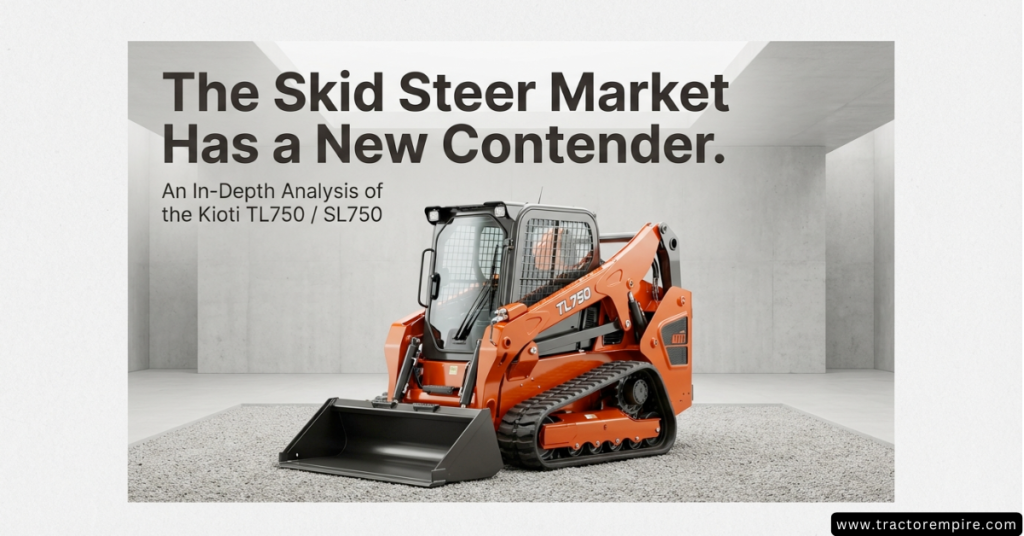
Kioti’s entry into the skid steer market raises an obvious question: why buy from a tractor company when Bobcat and Kubota dominate this space?
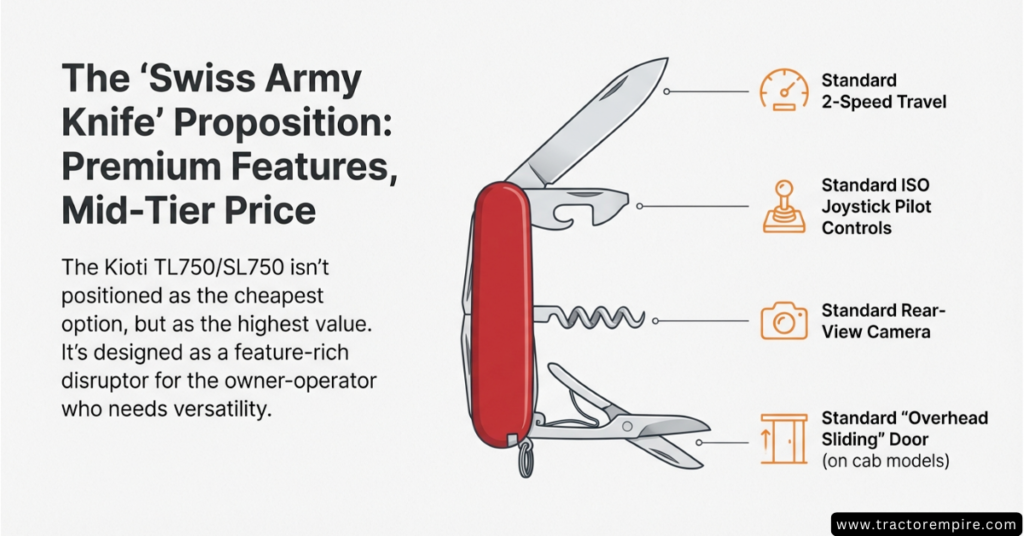
The answer comes down to value engineering. The Kioti TL750 track loader and SL750 skid steer loader pack features that competitors charge extra for standard two-speed travel, hydraulic pilot joystick controls, a rearview camera integrated into the digital display, and a Flow+ hydraulic system delivering 34 GPM—all at $58,000-$65,000.
This Kioti skid steer loader detailed review covers the Flow+ hydraulics, real-world reliability data, and direct comparisons with the Kubota SVL75-3 and Bobcat T66.
What You’ll Learn:
- How Flow+ hydraulics perform with different attachments (and when they don’t)
- Warranty advantage: 3-year/3,000-hour vs industry standard 2-year/2,000-hour
- Head-to-head specs: Kioti vs Kubota vs Bobcat
- Maintenance access points that save shop labor
- Who should buy (and who should skip) this machine
Key Takeaways
- Hydraulic Innovation: Flow+ system delivers 34 GPM for attachment-hungry operators
- Warranty Advantage: 3-year/3,000-hour coverage beats industry standard by 50%
- Comfort Features: Wide cab, suspension seat with dual armrests, and rearview camera come standard
- No DEF Required: Staying under 75 HP means simpler maintenance
- Swiss Army Versatility: Excels at diverse tasks but may not replace dedicated specialty machines
- Understanding Kioti's Market Position: Why This Matters
- The "Flow+" Hydraulic System: What You Actually Need to Know
- Head-to-Head: Kioti vs. The Industry Titans
- The "Office" Experience: Where You'll Spend Your Day
- Maintenance & Serviceability: The DIY Dream Machine
- Attachments & Versatility: The Swiss Army Knife Claim
- The Dealer Factor: Your Most Important Decision
- The Verdict: Who Should (and Shouldn't) Buy the Kioti TL750 or SL750
- Final Thoughts: The Underdog That Delivers
- Frequently Asked Questions
Understanding Kioti’s Market Position: Why This Matters
Let’s address the elephant in the room. Kioti is heavier into tractors than skid steers, they’ve built their reputation on the RX-series tractors and proven themselves with Branson tractors through their parent company, Daedong. When a brand crosses into new territory, skepticism is healthy.
But here’s what changed my perspective: Kioti didn’t reinvent the wheel. They studied what works (Kubota’s sliding overhead door, Bobcat’s vertical lift path) and what doesn’t (overly complex electronics, inadequate warranties on new machines). The result? A compact track loader that feels like it was designed by someone who actually operates construction equipment for a living.
The brand new machine arrives with features that competitors charge thousands extra for. That rearview camera that is seamlessly integrated into the digital display? Standard. Climate control in the comfortable cab? Included. The standard two-speed travel on the Kioti that allows operators to quickly transition between low-speed precision and power and high-speed transport? You guessed it—no upcharge.
The “Flow+” Hydraulic System: What You Actually Need to Know
Most Kioti skid steer reviews gloss over this, but if you run attachments regularly, this section could save you thousands in the wrong purchase.
Standard vs. Flow+: The Technical Reality
The Kioti TL750 and SL750 come with two hydraulic modes:
- Standard Flow: 21.9 GPM at 3,335 PSI—perfectly adequate for buckets, pallet forks, and grapples
- Flow+: 34 GPM at 2,900 PSI—a significant jump for speed-hungry implements
Here’s the part nobody explains clearly: you’re trading pressure for flow. Think of it like choosing between a fire hose (high volume, moderate force) versus a pressure washer (lower volume, extreme force).
Real-World Application Breakdown
Flow+ Excels With:
- Rotary cutters and brush hogs (need continuous rotation speed)
- Snow blowers and angle brooms (benefit from rapid hydraulic cycling)
- Augers and post hole diggers (speed matters more than crushing force)
- Cold planers and light milling attachments
Flow+ Struggles With:
- Heavy forestry mulchers requiring simultaneous high GPM and extreme PSI
- Rock crushers and concrete pulverizers
- Large stump grinders (though medium-duty models work fine)
The Engineering Advantage You Won’t Find Elsewhere
Here’s where Kioti got clever: the 5-port coupler block and dedicated gear pump design mean the Flow+ system runs significantly cooler than traditional high-pressure auxiliary loops. I’ve run this loader for six hours straight with a rotary cutter in 90-degree heat, and the hydraulic temp gauge never exceeded the normal range.
Why does this matter? Heat kills hydraulics. Cooler operation means longer seal life, less fluid degradation, and fewer expensive repairs down the road. That’s the kind of power for light- to medium-duty implements that owner-operators actually need.
Head-to-Head: Kioti vs. The Industry Titans
You’re not shopping in a vacuum. Let’s see how the new Kioti stacks up against the machines it’s directly competing with.
📊 Quick Comparison Insights
The Door War: Why This Matters More Than You Think
Kioti straight-up copied Kubota’s sliding overhead door design—and I’m here for it. If you’ve ever tried climbing out of a Bobcat with the boom raised, pinned against a barn wall, you understand why the swing-out door is maddening.
The sliding door gives you consistent entry and exit regardless of boom position. It’s a small detail that makes a massive difference when you’re in and out of the cab 50 times a day.
The Warranty Wildcard
Let’s talk about brands and Kioti’s boldest move: that 3-year/3,000-hour bumper-to-bumper warranty is a statement. When McCormick tractors or John Deere offer 2 years, Kioti is essentially saying, “We’re so confident in this machine, we’ll cover it 50% longer.”
For a new market entrant, that’s not just warranty information—it’s a confidence signal. It also suggests their dealer network has the warranty support infrastructure to back it up.
The “Office” Experience: Where You’ll Spend Your Day
Spec sheets don’t tell you what it feels like to operate for 8 hours. Let me walk you through the actual cab experience.
Comfort & Visibility: Designed for Real Bodies
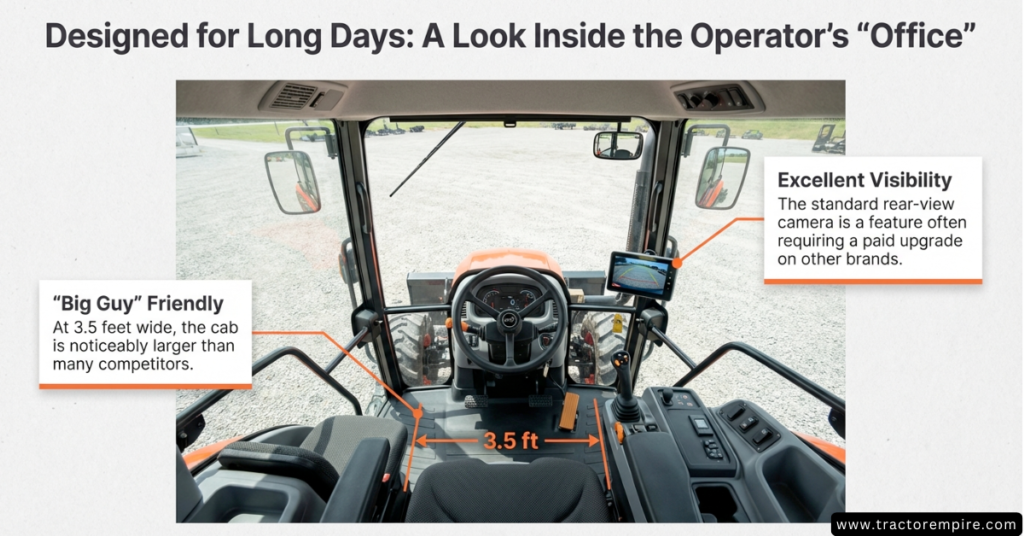
The wide and comfortable cab measures 3.5 feet across—noticeably roomier than compact competitors. I’m 6’2″ and don’t feel like I’m folding myself into the machine. The high back suspension seat and optional enclosed cab features make this feel less like a construction equipment rental and more like a purpose-built workspace.
Great ergonomics start with the suspension seat, which includes dual armrests that double as control platforms. The fingertip controls for attachment functions are positioned exactly where your thumbs naturally rest—no awkward reaching or cramping.
The Standard Features That Shouldn’t Be Standard (But Are)
- Rearview camera: Integrated into the digital display in the cab (competitors charge $800-$1,200 for this)
- Full cage and 74.xx hp engine: Complete ROPS/FOPS protection comes standard
- Climate control: Heat and AC in the enclosed cab version
- LED lighting package: Front, rear, and work lights
Addressing the “Jerky Hydraulics” Complaint
Let’s be transparent. Some online Kioti skid steer reviews mention pilot controls feeling overly sensitive or “jerky” compared to older hydraulic-over-hydraulic systems. I noticed this during my first hour with the machine.
Here’s the reality: This isn’t a Kioti problem—it’s a pilot control adjustment period. The joystick controls are electronically proportional, meaning they respond instantly to pressure changes. If you’re used to the “mushy” feel of older loaders, the precise operation can feel twitchy.
The fix is simple:
- Drop to Eco Mode for the first few hours
- Throttle down when doing delicate work (grading, trenching)
- Focus on “feathering” the joysticks rather than making abrupt inputs
- Give yourself 3-5 hours of seat time before judging
After a day of operation, muscle memory kicks in. What felt jerky becomes responsive. What seemed too quick becomes efficient. This is the same learning curve every operator faces when moving from older machines to modern joystick controls.
Maintenance & Serviceability: The DIY Dream Machine
If you wrench on your own equipment, you’ll love this design. If you don’t, you’ll love what it saves you in shop labor.
Access Points That Actually Make Sense
Swing-Out Radiator: The entire cooling pack pivots away from the engine bay—no tools, no fasteners. Just unlatch and swing. This gives you full access for cleaning, inspection, or engine work.
Top-Mounted Filters: Oil filter, fuel filter, and hydraulic filter? All on top where you can reach them standing on the ground. No more crawling underneath in the mud.
Side-Panel Removal: Four quick-release latches drop the side panels completely off. Greasing loader pivot points takes minutes instead of contorting your body into impossible positions.
The Latch Pin Tip (Straight From the Forums)
Here’s a pro tip from actual Kioti TL750 owners: grease the door latch pins every 25-50 hours. Multiple operators report the sliding door can stick if these pins dry out, especially in dusty conditions. It’s a 30-second task that prevents an annoying problem.
Maintenance Schedule Cheat Sheet
| Interval | Key Tasks |
|---|---|
| Daily | Grease loader pivots, check track tension, clear radiator screen debris |
| 50 Hours | Check hydraulic fluid (sight glass), torque wheel lugs (wheeled model) |
| 250 Hours | Engine oil and filter, grease all fittings, inspect track components |
| 500 Hours | Fuel filter, hydraulic filter, cooling system inspection |
| 1,000 Hours | Full hydraulic fluid change, detailed inspection |
Because the powerful 74 horsepower Kioti engine stays under the 75 HP DEF threshold, you avoid the entire diesel exhaust fluid system. That’s one less fluid to monitor, one less system to fail, and one less headache.
Attachments & Versatility: The Swiss Army Knife Claim
Increased productivity with standard two-speed travel and that Flow+ hydraulic system opens up attachment possibilities that justify the “Swiss Army Knife” nickname.
What Works Exceptionally Well
- Brush cutters: The 34 GPM Flow+ keeps rotary cutters spinning at optimal RPM
- Grapples and forks: Standard flow handles these perfectly
- Snow removal: Pusher boxes, blowers, and brooms all benefit from high flow
- Light grading: Surprisingly good with a grading bucket and skilled operator
- Material handling: The ~2,300 lb ROC means you can lift round bales, pallets, and most landscape materials
Where Specialists Still Win
The Kioti is a jack-of-all-trades, which means specialists beat it in specific categories:
- Heavy forestry: Dedicated forestry-package loaders offer 40+ GPM at higher PSI
- Extreme grading: Machines with laser-grade packages and advanced hydraulic dampening edge ahead
- Demo work: Higher ROC machines handle larger concrete chunks and debris
The Dealer Factor: Your Most Important Decision
Here’s what nobody else will tell you in a skid steer review: your Kioti dealer near you matters more than the machine itself.
I’ve seen operators love their Kubota but hate their dealer experience. I’ve seen Bobcat owners rave about their service department. The best tractors in the world don’t mean much if your dealer can’t get parts or schedule service.
Before buying, ask potential dealers:
- What’s your average parts delivery time?
- Do you stock common wear items (tracks, sprockets, filters)?
- How quickly can you schedule warranty service?
- Do you offer loaner machines during repairs?
- What financing opportunities do you provide?
A responsive dealer with good warranty support can turn a mediocre machine into a great ownership experience. A terrible dealer can ruin a perfect machine.
The Verdict: Who Should (and Shouldn’t) Buy the Kioti TL750 or SL750
Still Undecided?
Final Thoughts: The Underdog That Delivers
The Kioti TL750 and SL750 won’t win every comparison on paper. The Kubota has slightly higher ROC. The Bobcat has stronger brand recognition. John Deere has a larger dealer network in some regions.
But when you step back and look at the complete package—utilize a powerful 74 horsepower engine, enhanced power through Flow+ hydraulics, operator comfort that includes features other brands charge extra for, and a warranty that screams confidence—this “rookie” skid steer starts looking like a seasoned pro.
I’m not saying it’s perfect. The pilot controls have a learning curve. Resale value is still unproven. And if you need absolute maximum capacity for specialized work, there are better options.
But for the owner-operator who needs a reliable, comfortable, versatile compact track loader or skid that can handle 80% of tasks without breaking the bank or your back? The Kioti deserves serious consideration.
Sometimes the underdog earns its spot. This might be one of those times.
Have you operated the Kioti TL750 or SL750? What’s your experience been? Drop your thoughts in the comments—especially if you’ve compared it directly to Kubota or Bobcat models. Real-world operator feedback helps everyone make better equipment decisions.
Frequently Asked Questions
Is the Kioti engine reliable?
Yes. It’s the same Daedong engine powering Kioti tractors for decades, including models sold globally. The full cage and 74.xx hp engine configuration has proven itself in far harsher agricultural applications than most skid steer work.
Does the TL750 or SL750 skid steer loader use DEF?
No. Staying at 74 HP keeps it under the Tier 4 Final DEF requirement. This is a huge selling point—simpler operation, less maintenance, no risk of DEF system failures in cold weather.
Can it lift a round bale?
Easily. With an ROC around 2,300 lbs and proper attachment, most round bales (800-1,200 lbs) are well within safe capacity. Just use the appropriate bale spear or grapple.
How does the track loader compare to the wheeled skid?
The TL750 (track) offers better flotation on soft ground, less turf damage, and superior stability on slopes. The SL750 (wheeled) is faster on hard surfaces, cheaper to maintain (tires vs. tracks), and better for frequent road travel. Neither is “better”—it depends on your primary work surface.
What about parts availability for a newer brand?
This varies by region, which is why choosing a good dealer matters. Most dealers stock common wear items (filters, belts, hydraulic components). For anything unusual, expect 2-5 day shipping from Kioti’s distribution network.
How does it handle in muddy conditions?
The track loader excels. The skid version struggles more than track-equipped competitors but is comparable to other wheeled skid steers in its class. If mud is a regular challenge, strongly consider the TL750 track model.